Case Study in Brief
Description
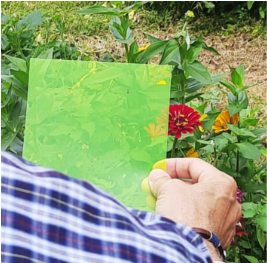
This activity engaged elementary school students and families. We chose colour-filtering glasses as sensory-altering tools. Children chose their glasses to look at their surroundings and then painted parts of a logo while wearing them. The activity enabled the sharing of experiences and impressions on the different meanings of colour and how light and vision work together in the human eye.
Dispatch From the Field
The key concept of the “Invisible” series is for participants to deepen their understanding of an environment. By alternating sensory capacities, hidden elements become visible.
Our university’s biology faculty organizes an annual school garden feast for nearby elementary schools and local residents (mostly families with younger children). At quite short notice we were given the opportunity to set up an activity station – and had to adapt an activity to the target group of younger children (elementary school or pre-school children).
We chose to apply a simplified version of “Invisible” and use colour-filter glasses as sensory altering tools to encourage observation, hands-on action (as painting) and discussion.
Preparation/ Engage
We repurposed a set of 3D glasses with colour-filtering film in different shades. Also, we prepared three canvases with an outline of the University logo divided into sections to paint in.
Participants came by our station and were encouraged to try out the sensory-altering colour-filter glasses.
Sensory exploration phase
We asked children and their parents to try on the glasses and to take a look around the space while wearing them. Many children felt the urge to share their observations with each other or their parents, intuitively engaging in talks.
We then gave each participant a choice of different colours they could use to paint with while wearing their glasses. In this way they could not see the real colour but a filtered version. As they started painting, we asked what colour they thought they were using before taking off the glasses and check it. Afterwards they were invited to switch glasses and pick out another colour (or a mix of colors) but this time they were asked to guess what colour they would be seeing before putting on the glasses. Then they painted another spot on the logo.
Sharing and Feedback
Sharing experiences and observations, asking questions, discussing ideas etc. was always cheered – as well as further exploration of different glasses and colours.
Practical Details – Facilitator’s Notes
How did you modify the activity?
Due to the young age of the target group and the informality of the event, the activity was designed in a simple form and adjusted to run in a short period of time. Reflection and discussion therefore were largely happening in the moment through co-experiencing and discussing with all participants at the activity station at that time.
Sharing and feedback were encouraged during the whole process.
How did you organize the space?
Two tables (1 with material and 1 with the canvases) put in a small path between garden parts with higher grass.
Who did you work with?
Elementary school students, families and children that could freely engage in activities of their choice.
What resources did you use?
- 2 Tables. 3 canvas (60×60) with a graffiti on them.
- 8 colour-filter glasses.
- Several sets of cups (with water).
- Different acrylic colors, paint palettes, pencils.
- Cleaning material: Soap, detergent, paper towels, sponges, bucket of water & empty buckets, trash bags.
What did you learn?
Everybody likes painting – the adults and teachers wanted to participate as well! Some talks with the children went into surprisingly scientific directions – and (individual) sensorial perception is something everybody can experience, relate with and communicate about.