Case Study in Brief
Description
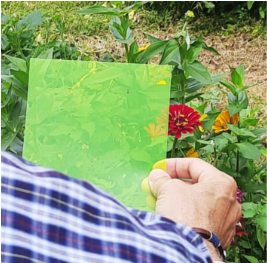
Inspired by “InVisible” this activity focuses on raising awareness of sensory perception. We played with sensory-altering tools to engage participants with the different ways we come into contact with the surrounding environment.
Dispatch From the Field
The session was led by an experienced university student and attended by undergraduate students and two professionals in science education.
Experiments: Engage & Explore
We first started with a number of independent sensory experiments aimed to stimulate awareness of the highly subjective and changeable ways humans can perceive stimuli from the environment and how they may react to those.
In one part of the experiments we made use of sensory-altering tools:
- Blindfolded tasting: Participants were given a set of masks or scarves to blindfold themselves. They sat in a circle, and were served a cup of coffee that had an extra ingredient each, for example pepper, sugar, lemon juice. They tasted their drink one after another and shared their experience – suggesting what extra ingredient they got.
- Blindfolded feeling: In the same setting, the attendees each got an object put in their hands and had a few seconds to feel it. Then all objects were passed to the next person and again the group had some time to examine it with their hands. This went on until everybody had their first object back in their hands. Then the facilitator asked the group to guess the different items – they had to discuss and agree on all the items they thought they held.
The second part of the experiments focused on consciously experiencing effects and stimuli that affect the body and sensorial perception:
- Elevator Ride: Focusing on different feelings in the elevator – movement (acceleration & breaking and how to modify it, e.g. by jumping), sensory perception (sight & smell & sound and how this affects our wellbeing, e.g. sense of enclosure, fear…)
- Sprinting up a stairway: Focusing on stimuli in different parts of the body – thinking about tension, exertion, pain, exhaustion etc. in different body parts.
- Fear of heights: Walking on the roof and looking down a deep (ventilation) shaft – experiencing and discussing different perceptions (like fear, uneasiness, call of void…).
Sharing & Feedback
At the end of every independent experiment, we opened up a space for participants to share what they experienced or observed. They tended to share personal memories the had associated with certain sensations.
The diversity of individual perception within collective exploration and the relation to prior experiences led to further conversation about inclusion and exclusion as well as discussions about ability and disability and access also arose.
Additionally, participants came up with further ideas for homemade sensorial experiments.
Practical Details – Facilitator’s Notes
How did you modify the activity?
The parent was strongly modified to suit the aim of putting sensorial perception to the core, leading to considerations or even explicit conversations about inclusion, (dis)ability, and access.
As the number of experiments to conduct and discuss is easy to modify, the duration can be adapted to suit the context.
Each experiment with discussion took about 10-15 minutes – in our case we conducted the activity within approximately 1 hour and 15 minutes.
How did you organize the space?
We used a space where participants could move freely and where we could gather for sharing and reflection.
Who did you work with?
While an experienced university student (prospective physics teacher) prepared and facilitated the session, a junior and a senior academic staff member (professionals) attended, as well as 4-5 university students (undergrads) between the ages of 18 and 25.
What resources did you use?
- Cups with coffee (or another drink) and spices/ liquids to modify the taste with
- Different common objects to feel (like a stapler, orange, bracelet etc.)
- A building with access to an elevator, a stairway, and some place to perceive height (rooftop, balcony etc.)
- Other resources depend on other ideas for homemade sensorial experiments.
What did you learn?
Sharing experiences leads to sharing stories.
Sharing stories leads to empathy.
Empathy leads to thinking about variety, diversity, in-/ exclusion.