What actually is a Roadmap?
A roadmap is a strategic planning technique that places a project’s goals and major deliverables, such as tasks and milestones, on a timeline. It is important to be precise, concise, and formal when creating a roadmap, and to choose appropriate vocabulary that is widely understood. Grammatical correctness, such as correct spelling, is also essential.
Since the 1960s, roadmaps have been used as a strategic planning tool to support communication and consensus among key stakeholders in an organization, industry, consortium, sector, or nation. The primary function of roadmaps is to communicate a vision, key resources, and essential steps required to achieve that vision. As such, they blend elements of explorative or normative foresight with action planning.
SENSE. builds on two different perspective to tackle all issues a roadmap for STEAM-education in Europe needs, in order to be able to address a wide range of stakeholders: The W-strategy and the M-strategy.
The W-strategy
The SENSE. Roadmap rests upon the layers often used for formal road mapping activities, namely the Why layer, What layer, How layer, a When dimension and the action plan layer (which would in fact be defined by the individual stakeholders based on their starting point in the roadmap as well as their specific goals). This approach delivered the best results for our purposes as it seemed to be best projectable on the SENSE. Project’s digital hub.
In this format, the Why layer relates to the EC’s target policy areas such as green deal, work readiness, digitization, and healthcare. This layer also relates to the value chain of STEAM approach in general, which can ultimately also serve those EC policy areas.
The What layer connects the theoretical dimensions of SENSE.STEAM approach with assessment and impact evaluation, and links to the Why layer of the roadmap via the value chain of STEAM. The What layer’s practical material for evaluation and impact assessment and needs assessment also link to the roadmap’s How layer.
The roadmap’s How layer links to the learning companion and all other practice-oriented material developed during the project such as the STEAM activities implemented by the Labs. Furthermore, the components of the How layer that directly deal with implementation of the SENSE.STEAM approach, link to the Why layer because the reasoning to do things differently is intrinsically linked to the why question.
Try our Roadmap implementation checklist here: LINK
The M-strategy
The SENSE. roadmap is designed to be flexible and applicable in various educational settings and supporting organizations. Thus, stakeholders in STEAM education can select relevant components based on their specific needs and institutional capacities. The roadmap serves as a guide for integrating the SENSE. approach into STEAM education in the micro, macro and meso sphere. The SENSE. roadmap aims to engage diverse stakeholders through combining different roadmap strategies into an individual “action plan” tailored to their individual roadmap towards STEAM, detailing practical steps and necessary resources for achieving their goals. Besides the A- and the M-strategy the SENSE. roadmap addresses to consider three distinct structural spheres:
- STEAM micro-sphere: STEAM teachers and classes
The initial step in adopting the SENSE.STEAM approach involves raising awareness. At the micro-sphere level, teachers and classes can quickly familiarize themselves with the SENSE. approach by participating in STEAM Labs and their associated events and training. These labs aim to enhance the knowledge and skills of teachers and students in two areas: 1) integrating artistic practices based on human senses into science education, and 2) enabling students to develop their skills through process-based learning pedagogies. This should lead to the establishment of ‘integrated STEAM subjects’ in schools, revising science courses accordingly. Teachers can customize these subjects by combining disciplines like physics and art, considering available teaching space. New STEAM topics will evolve through methodologies such as design-based research (DBR).
- STEAM meso-sphere: STEAM education networks
This plan can also be implemented within educational networks or communities, termed STEAM meso-sphere, where participants take on various roles. Stakeholders will have distinct action plans but should coordinate for optimal results. Once all parties are identified, forming a coordinating group is essential, followed by creating a unified schedule for each participant’s role (e.g., education, work experience assistance, curriculum development).
- STEAM macro-sphere: education systems
At the highest level, the combined plan can serve as a reference for enhancing STEAM education across national and transnational education systems and the European education and research area—termed the STEAM macro-sphere. Widespread adoption of the roadmap necessitates redefining science education in primary, secondary, and tertiary institutions according to the principles of the STEAM and SENSE.STEAM approaches. Education policies must recognize the importance of a unified approach to science education, forming the foundation of its infrastructure. Improving discourse around STEAM education is crucial, involving key individuals and organizations such as lawmakers, government departments, universities, and schools.
Accessing the roadmap through the digital hub
To ensure accessible and inviting language, enhance user-friendliness, and create multiple pathways for engagement with the SENSE. roadmap, we successfully integrated the W-strategy, M-strategy, and AAA strategy, drawing on valuable insights from WP3 and WP4. This collaborative effort culminates in the New European Roadmap to STEAM Education.
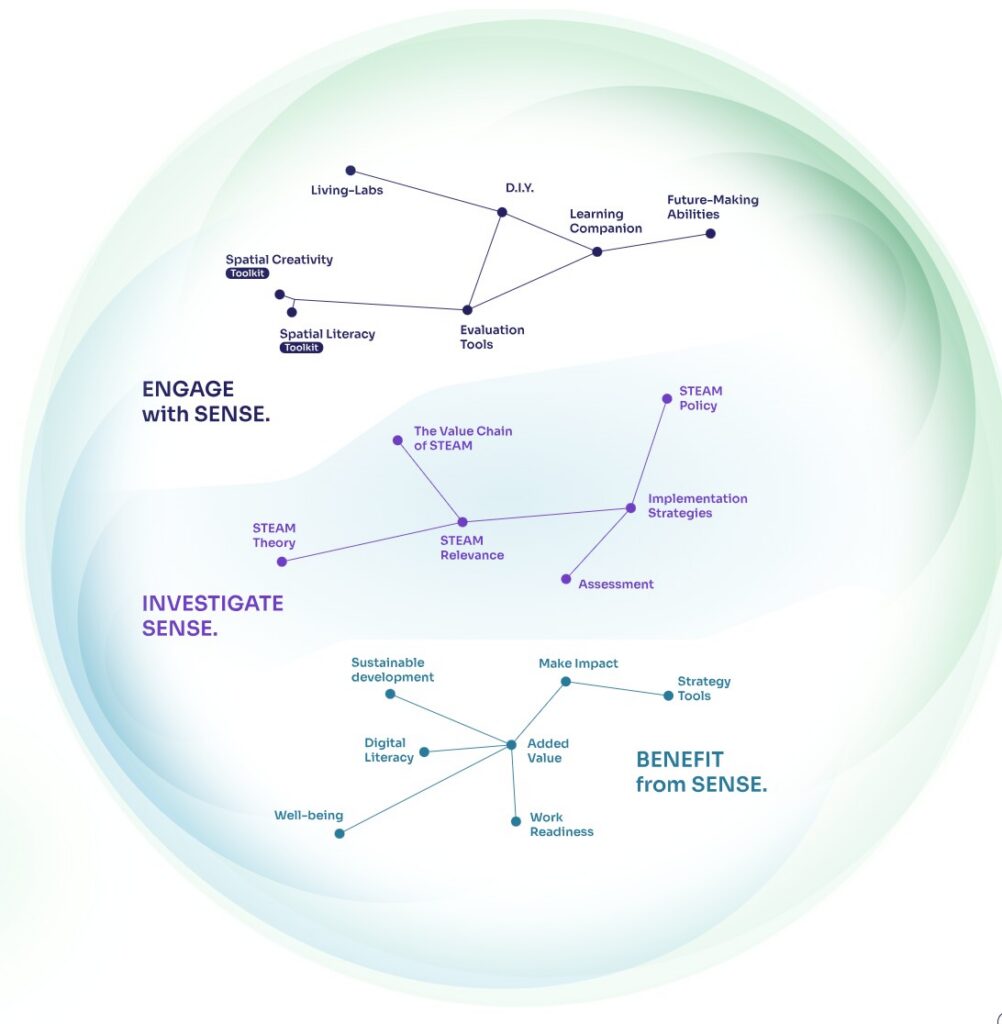
In our design approach, we moved away from the traditional “road” metaphor and instead developed a visualization inspired by the idea of stellar constellations.
We have also rephrased the Why, What, and How layers to apply the meta-roadmap strategy to practical contexts:
ENGAGE with SENSE. (The How layer)
This layer provides actionable methods for getting involved in STEAM education. What steps can you take to actively participate? How can collaboration enhance your engagement?
BENEFIT from SENSE. (The Why layer)
This layer details the impact and significance of STEAM education. What are the key benefits of STEAM for you and your community? Why is it essential to integrate STEAM into education today?
INVESTIGATE SENSE. (The What layer)
This layer explores the foundational aspects of STEAM education. What are the core principles of STEAM? How does STEAM education foster critical thinking and problem-solving skills?
The configuration of connections among the components of each of the three layers implies that stakeholders intending to use the roadmap can chose their “departure point” as well as their “destination” according to their needs – there is no strict start node and end node in the roadmap. Nevertheless, one can expect that based on a selected starting point, the most relevant next steps are suggested to the user.
Also, it is important to note that the tools and guidelines applicable at each layer of the roadmap are clearly mentioned in Annex 2 of this document. These tools and guidelines are available from the reports produced by the SENSE. Project, and are accessible from the project’s digital hub.