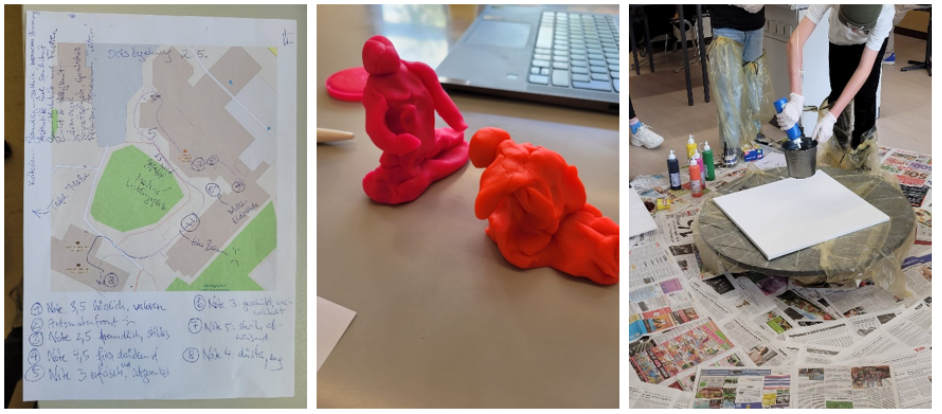
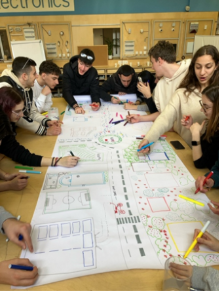
A centrally running theme for participants working with Odyssea (Greece), GEYC (Romania), PHW (Germany) and WECF (Georgia) was to give young people space to explore/discuss/re-imagine their own community and how it addresses their needs. SENSE. appears as a means to counteract the discourse of disenchantment with current educational practices and actively re-configuring the way people see themselves as playing an active role in their society. This was done physically and actively through a mapping tool. For example, the activities “building a house for a fairy, “mapping favourite places”, the skin of the world” conducted by GEYC with 10 groups of young people across different sites in Romania, acted as a powerful mediator between the political dimension concerned with what spaces are available to youth, and the aesthetic domains, as what spaces may favour social interaction and discussion on matters that affect young people directly in their own communities.
Favourite Places in Romania
GEYC organised a series of meeting with groups of young people using the reorganised space of a local library. Care was taken to make sure the library spaces were used flexibly with opportunities to move chairs; to use nooks and crannies and cosy areas as well as using the outside space. This approach contrasted starkly with the traditional way of teaching and how classrooms are organised in schools; the mapping activity on favourite places disclosed a variety of experiences and concerns from the young people (for example lack of lighting in the streets and evidence of drug use in public areas), who felt there was a great need to find spaces and opportunities for them to discuss.
Improvisation and empowerment in Georgia
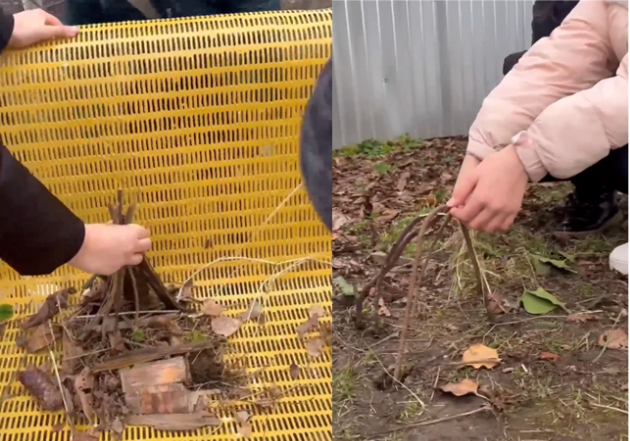
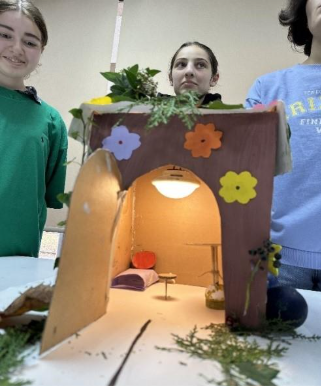
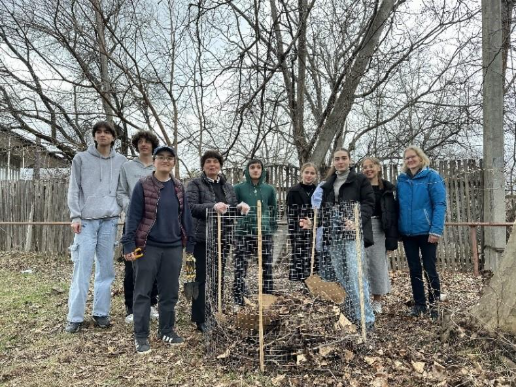
WECF in Georgia involved a group of girls attending the STEM club held after school over a period of 10 weeks to engage with a STEAM approach that brought them into contact with the dimension of the senses and their own imagination, as central elements of being a girl in science. Working in a setting with limited resources and often reliant on ready-made kits obtained from or donated by business companies, the WECF Lab introduced the girls to a wide selection of activities and sequences, each time engaging them with different aspects of the STEAM approach: from playful imagination to critical reflection on their own learning and the perception of themselves as ‘innovators’ in the Georgian society. Interestingly, the new activities offered the chance for the girls to integrate some of the STEM designs and prototypes they had produced prior to becoming involved with the STEAM Lab thus expanding their idea of what it means to work in science while critically reflecting on its role and value in society and the environment. The experiences outdoors were also new for this group, often not being considered as a space for educational activities: for example it became apparent that making the house for a fairly model might have worked better outside, as they mapped the spaces that were most suited, rather than indoors; similarly, scientific observations of soil could be conducted easily indoors but the experience of making compost outdoors was a new experience that became more relevant to them over time.
Lessons Learned in Greece
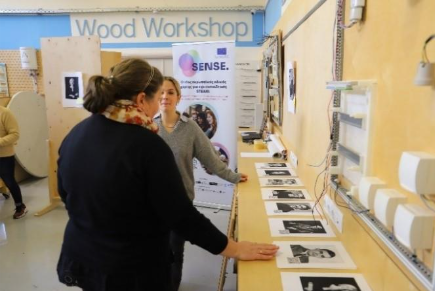
ODYSSEA ran 10 sessions with groups of young people using activities involving make and create – such as gender portraits and article from the future – which were designed to engage participants directly, hare and challenge held perceptions and to stimulate imaginative thinking. It became apparent that a certain lack of familiarity with this approach was common and both space and furniture were a critical dimension to be actively considered for this type of pedagogy.
Experiential Learning in Germany
In Germany, PHW worked with different groups of students, at University and secondary education level, to introduce them to a form of experiential learning to connect the abstract knowledge of science courses with greater engagement with their own experience of sensing colour and materials and making sense of their own environment. Mapping and drawing were facilitating approaches in this case to draw students out and lead them out to practice with approaches that were more open-ended and allowed for creative and affective responses to places and materials, exchange of perspective and empathy while working with other people and considering other creatures in the environment outdoors.