Case Study in Brief
Description
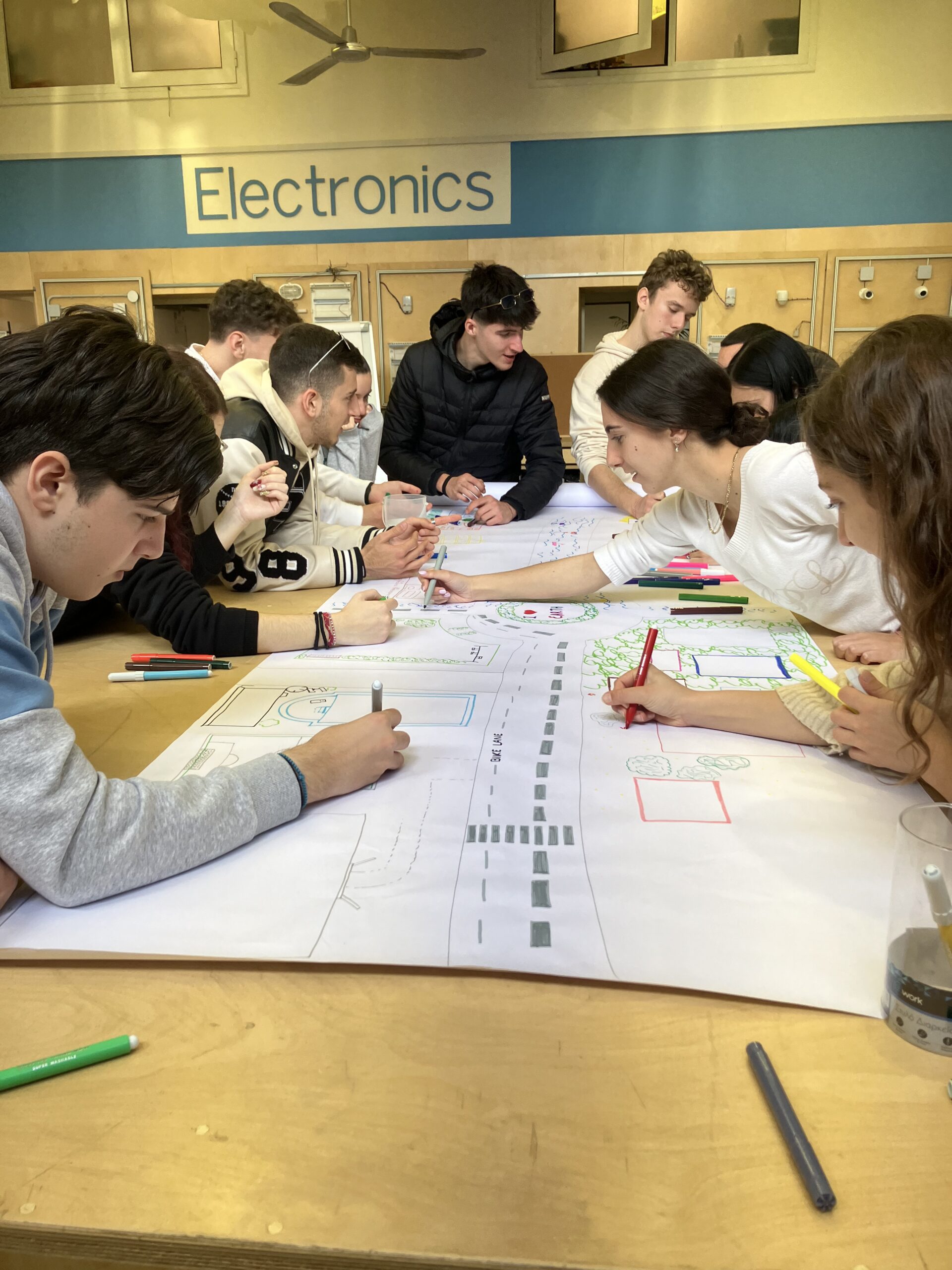
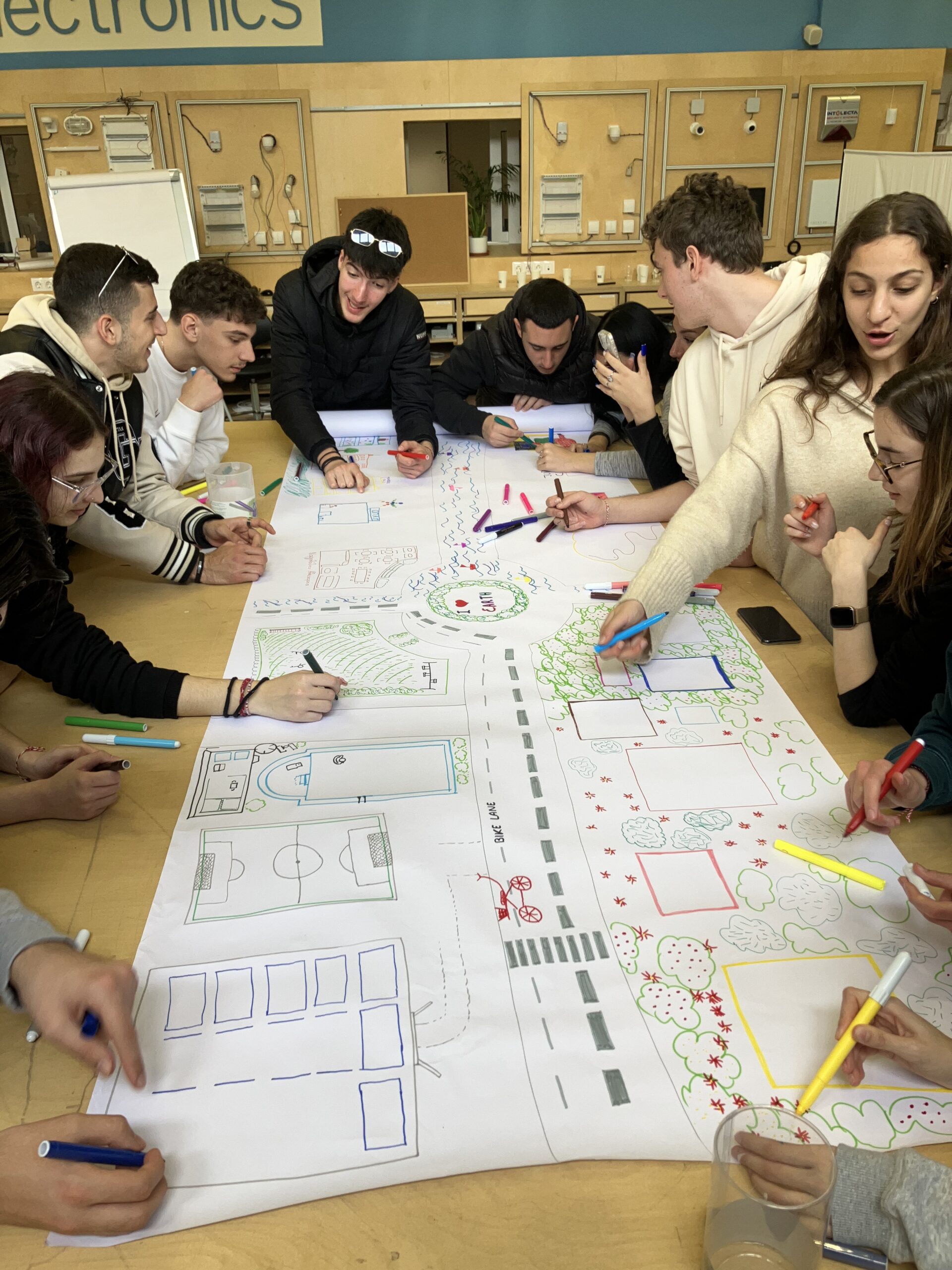
In this learning sequence, we facilitators use the future neighborhood activity, which we adapt to the group we worked with. During the activity, we ask the children to draw their future neighborhood (they decided that this neighborhood would exist after 100 years). We then ask the children to divide into groups of three and write one micro-story, which would be a slice of life of the hero they would create. This hero is set in the neighbourhood they drew, and the incident reflects a slice of their everyday life. The stories have given us the stimulus to talk about gender roles in a future society.
Dispatch From the Field
Envisioning Tomorrow’s Landscape (15-20 minutes)
Future-Forward Framing: We begin by sparking curiosity about future trends:
“Consider the world around us today – the technologies emerging, the environmental shifts, the evolving ways we live and work. Now, let’s creatively imagine how these trends might converge and transform our neighbourhoods 100 years from now. What innovative solutions might arise?”
Designing the Future Neighborhood: We provide drawing materials and encourage imaginative design:
“Using your artistic skills, sketch a future neighborhood that reflects these potential changes. Think creatively about sustainable architecture, transportation systems, green spaces, and community hubs. How might technology seamlessly integrate into the urban fabric? What new forms might familiar structures take?”
Imagine citizens of tomorrow (20 minutes)
Forming Innovation Hubs: We divide the children into small collaborative groups:
“Now, as teams of future thinkers, you will imagine the individuals who inhabit these innovative neighborhoods. Brainstorm the kinds of professions and roles that might exist in this future. Consider how current jobs might evolve or what entirely new fields might emerge due to technological advancements or societal shifts.
A Day in the Life: Micro-Narratives of Progress (15 minutes)
“Create a compelling hero who has a meaningful occupation within your future neighborhood. What skills and knowledge might they possess? Imagine a typical workday for your hero. Craft a concise micro-story that captures a significant moment or routine task in their professional life within this future context. The incident should highlight the innovative aspects of their work and the surrounding environment.”
Sharing Insights (15-20 minutes)
Presenting Future Concepts: We then invite each group to share their creations:
“Step forward, future architects and sociologists! Present your vision of the future neighborhood. Explain the creative choices behind your design and the potential innovations it embodies.”
Reflecting on Creative Futures: We then facilitate a discussion focused on creative problem-solving.
“What creative solutions did you incorporate into your future neighborhood design? How does imagining these future professions help us think about the skills needed for tomorrow? What innovative ideas emerged from blending visual design and narrative thinking?
Practical Details – Facilitator’s Notes
How did you modify the activity?
Our activity lasted 50-60 minutes, but the time may vary depending on the age group of the participants.
How did you organize the space?
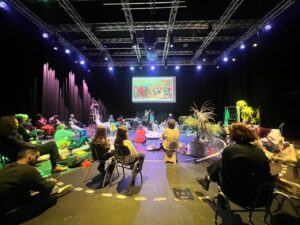
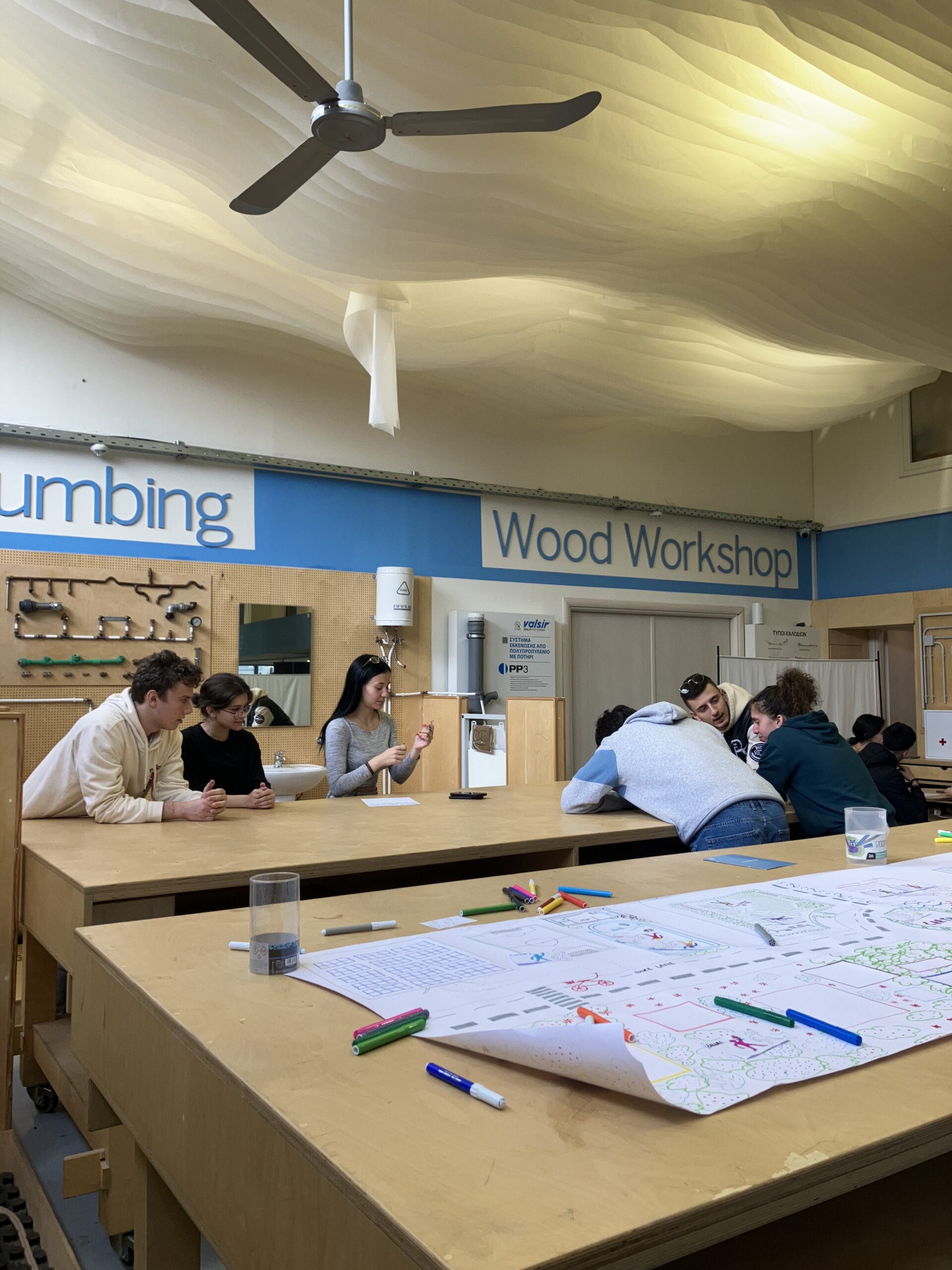
In the space, there is a big table that children use to draw the map. As the space is big and open, smaller groups had the chance to find their own corner and work in a focused way.
The space has plenty of light and is ideal for large groups. All the furniture is made of the same wood, in the same neutral tones, so there were no distracting elements.
Because it was an open space and there were other people on the premises for other classes, the space could not be completely sound-controlled.
Thanks to the very high ceiling, the students could have visual control, and so could the instructor. We made sure that there were several smaller tables in the space so that smaller groups could work with the necessary isolation.
Who did you work with?
The children we worked with attend the 3rd and last grade of high school. This is the class that leads to the national examinations for university. The children are 17 years old. The activity also involved two of their teachers.
What resources did you use?
Everyday Objects: We selected itemsthat could be used as 3-D additions to the design of the neighborhood.
Adhesives: Glue sticks or sticky tack (Blu-Tack) to attach objects to the pictures.
Writing Tools: Pens or pencils for creating brief bios or notes.
Drawing paper
Instruction Sheet: A short guide with prompts/questions
What did you learn?
The children had the necessary space and felt safe to express their views and listen to the opinions of their peers.
The children’s enthusiasm was widespread, and this was evident in the enthusiasm they showed for the activity. They all wanted to participate and express their views.
After completing the activity, the children were concerned and asked the teachers to continue the discussion when they returned to their classrooms.
Opinions were again expressed on the occupations that are male and female. Some of the children stated that they would not trust a male kindergarten teacher or a male cleaner. Similarly, they would like when they go shopping for clothes and bags to find a female salesperson. Men are the ones who would work in a betting shop or in a bar.
The activity, in general, went well. We believe with more time we could complete the discussion on gender roles, perhaps in additional meetings and activities. We focused on how we generalize individual incidents to create stereotypes.