
Case Study in Brief
Description
We exhibit a large map of a familiar place in a public space, along with clear instructions on how to participate. Members of a specific community, such as a school, company or municipality, can take part anonymously. Participants mark their favourite and least favourite places on the map and leave written notes with reasons or suggestions. The results can lead to publications, discussions or recommendations for how to improve or rethink the space.
Dispatch From the Field
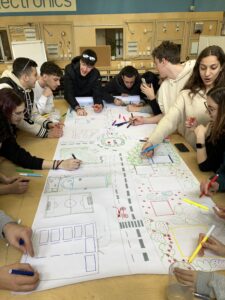
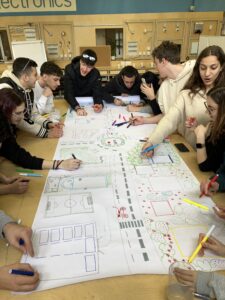
This version of the Favourite Places Mapping activity is designed and facilitated by students from a STEAM seminar at Weingarten University of Education.
Preparation
We begin by choosing a specific space, such as a building, area or district, along with a target group that uses or feels connected to it. In our case, we choose the science building on our university campus. We aim to engage different people who use the space, including university students, academic staff, administrative staff and guests.
Set-Up
We set up the following in the centre of the science building’s ground floor:
- A large map (A1) of the building attached to a pinboard. [Hint: use openstreetmap.org]
- A cardboard box with a slit to throw in flashcards.
- Stickers in 3 different colours (green, yellow, red).
- Flashcards & pens.
The also post clear instructions on how to use it:
- Everyone passing by is invited to place dots (stickers) on the map: green for places they like, red for places they dislike and yellow for places they feel neutral or mixed about.
- Participants also add a number to each sticker they place. They then write on a flashcard three reasons why the spot makes them feel that way. Each card goes into the box.
Pin Placement and Comments (“Reflection”)
We leave the map, materials and instructions in place for a few days to give many people the chance to join. The open format allows for flexible and anonymous participation.
Discussion and Conclusion
The university students who run the activity remove the setup after several days. By then, it looks like a collaborative artwork. They collect the flashcards and use them, along with the sticker data on the map, to start a group discussion within the course.
Together, we analyse the results. Based on the insights, we write a letter to university administration with a summary of the event, key findings and suggestions for improvements in certain areas. We also write a short article about the project and share it with fellow students.
Practical Details – Facilitator’s Notes
How did you modify the activity?
–
How did you organize the space?
–
Who did you work with?
–
What resources did you use?
–
What did you learn?
–
Related Case Studies
-
Mapping Favourite Places
Activity in brief “Favourite Places” engages participants in identifying and discussing their favorite and least favorite places on a map using colored pins. Participants examine ... Read more
-
Favourite Places
Activity in brief “Favourite Places” engages participants in identifying and discussing their favorite and least favorite places on a map using colored pins. Participants examine ... Read more