About the case study
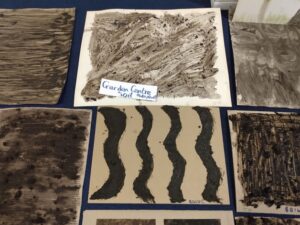
The workshop was organized by the Western Norway University of Applied Sciences (HVL) in April 2024, and the Bergen Chamber of Commerce coordinated attendance of company- or public institution trainees from various firms or public institutions (who were also participants of the TraineeVest programme coordinated by the Begen Chamber of Commerce) in the workshop. After an introduction about the SENSE project, and a session on needs assessment, the participants were organized in groups of about 3 or 4 members, and each group was provided with one type of leaf to conduct the activity. Each group’s members sat around a table, and one of the group members tried to find a suitable altitude from which to release the leaf, while all the group observed the falling pattern and consequently drew the pattern on a piece of paper. For instance, the leaves were released while a participant was standing on a chair, stretching their hand holding the leaf.
The drawings made based on the leaves’ falling were then exchanged between the groups; each group handed its own drawing to a group sitting next to them, and also received another group’s drawing. Consequently, each group had internal discussions and tried to guess which leaf was represented by the drawing they had received from another group.
‘Falling leaves activity provided a fascinating opportunity to contemplate about, and explain various principles of physics, such as motion, forces such as gravity, and air resistance. Different patterns of falling leaves — e.g. whether they spinned, fluttered, or dropped straight down — were used to explore those physics concepts and principles. While the observation of the falling leaves helped the participants to get acquainted with the physics phenomenon in a hands-on and empirical manner, the drawings triggered participants’ artistic inquiry. Furthermore, making guesses about corresponding leaf based on other groups’ drawings encouraged participants to use their imagination and imaginative learning capacity, leading to the combination of inductive and deductive inquiry modes in a unified STEAM activity.
Falling leaves activity is a special case in the taxonomy (the order of things) category of STEAM activities based on its stimulation of imaginative learning capacities of STEAM subject learners. This becomes evident during the stage of the activity when participants in the activity try to establish a relationship between the artistically-represented pattern of a leaf’s falling and the leaf’s physical characteristics such as its shape and weight. This capacity gets already nurtured at a previous stage of the activity, when participants observe the falling pattern of another leaf that they have already and closely described and noted its physical features. Accordingly, the falling leaves activity in fact stimulates and nurtures participants’ and learners’ abductive reasoning capacities too.
Reflections for Facilitators
Modifications to the parent
This activity deals with making informed distinctions among different types of leaves through an empirical experiment, and so it was designated as a taxonomy activity.
The activity was conducted over 1.5 hours. This was needed to give all participants – which in the mentioned workshop were divided in 7 groups – an opportunity to present their findings. This also made it possible to challenge the groups with a higher variety of leaves in the collection, based on which they would make guesses about the drawings they received. Nevertheless, the activity could be conducted with a lower number of groups – at least two groups.
Space
The space in the room was equipped with adequate number of chairs and desks for the 25 attendants of the workshop. For the falling leaves activity, the attendants were grouped in groups of about 3, and each group sat around a desk. Each group could select a leaf to conduct the experiment with, and could choose to release the leaf from an altitude of their own choice, for instance while standing on a chair.
Group
The group consisted of about 25 newly graduated young trainees employed by various firms or public institutions in Western Norway. The same group were also participants of the TraineeVest program coordinated by Bergen Chamber of Commerce, through which Norwegian firms from Western Norway had identified the trainees for employment in their firms or public institutions. These participants had variety of educational backgrounds, and were engaged with their respective employers in different organisational sections, such as IT, administration, economy, marketing, etc.
Resources used
To conduct the activity, participants in each group needed a piece of blank paper, a pen or pencil, and a collection of leaves to choose their leaf from. These were procured in advance by the organizers of the workshop, i.e. HVL staff.
Lessons learned
The activity was a clear indication that arts-based inquiry and scientific inquiry processes can be merged to enhance the learning outcome from observation of physical and real-world phenomenon. Specifically, the more sensitized learners get about the artistic qualities of representation of an observation, the better scientific argumentation capabilities they can develop. This was manifest from the fact that high level of attentiveness regarding the shape of a leaf and its effect on the pattern of the leaf’s fall from an altitude was gained when differences between drawings triggered discussions around various causes of those disparities.