
Why?
Action as research – that is an excellent start for a self-experimentation series. We know from cognitive research that people behave and think differently in different sized spaces. A tall space inspires creativity, and a confined space helps with focus. Many scientists incorporate walking as a means to stimulate their thinking, actively seeking different environments to gain fresh perspectives on ideas, thoughts, or problems.
A Stanford study from 2014 even found that moving improves creativity. Walking, thinking, creating, changing, inspiring, taking a break to ruminate together. These are familiar elements for thinkers, artists, academics and many more. So why is this not more widely used? So let’s do it!
The experience of moving together and altering our spatial setup as we go can invigorate our usual group practices and foster improvisation. This activity will disrupt the norm and provide valuable insights into how our practices relate to our spatial surroundings.
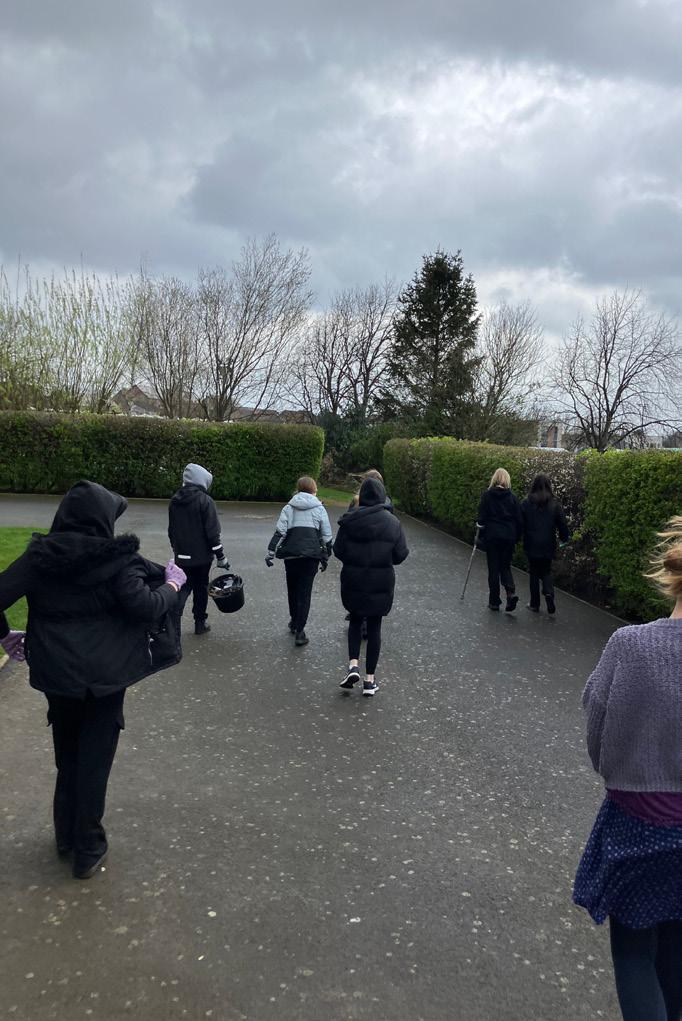
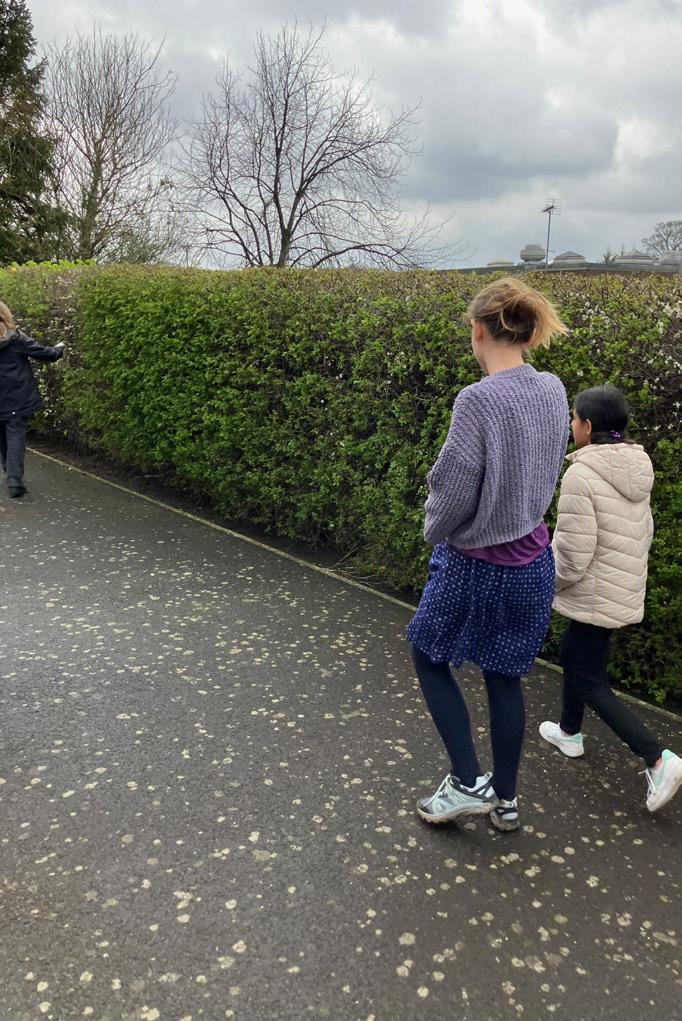
What might appear to be a leisurely autumn stroll is actually a group of participants in a lab activity walking from an indoor space to the garden. Gardening activity is an integral part of the STEAM lab to holistically reconnect home
economics students with the natural source of food production. The act of changing the environment from indoors to outdoors helped embody this link but also had a cathartic effect in getting the participants into the right, liberating mindset to engage with the natural environment.
How
The principle behind this experiment is straight- forward. Begin by planning your activity as usual, then select a different space to conduct it in.
Keep these two key principles in mind:
- The spaces must be noticeably different from each another. If both spaces are similar, there is little benefit in switching from space A to B.
- The act of moving is crucial, as it “resets” your brain and allows for new impressions. This means that “moving” should be an integral part of the activity and should take place within (and not between) the sessions.
And finally, as with all of the experiments in this document, the spatial experience should be jointly reflected after each session.
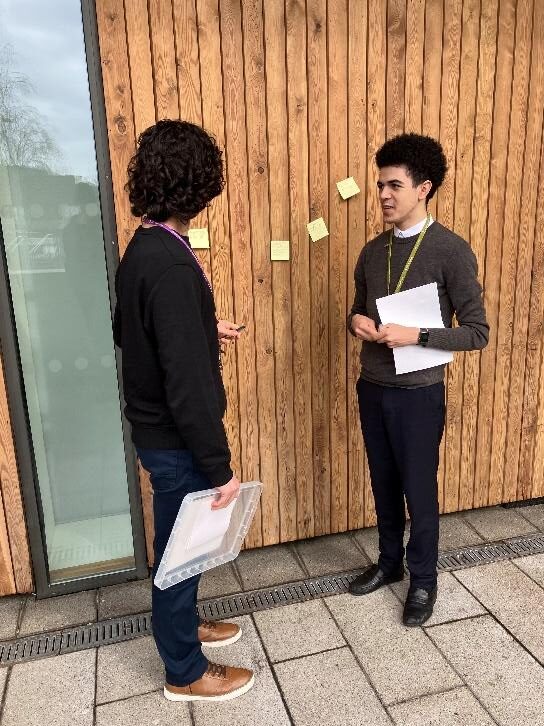
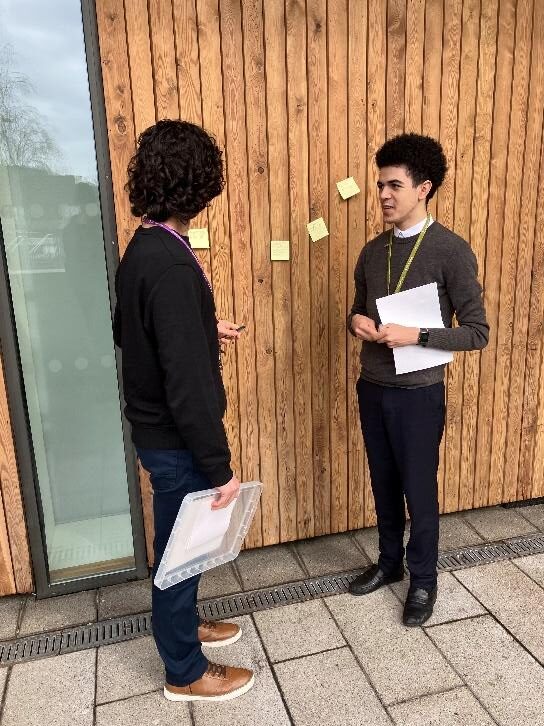
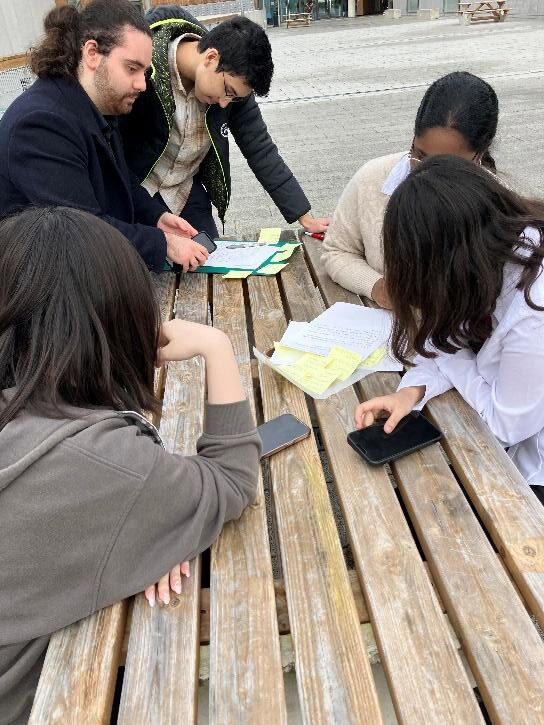
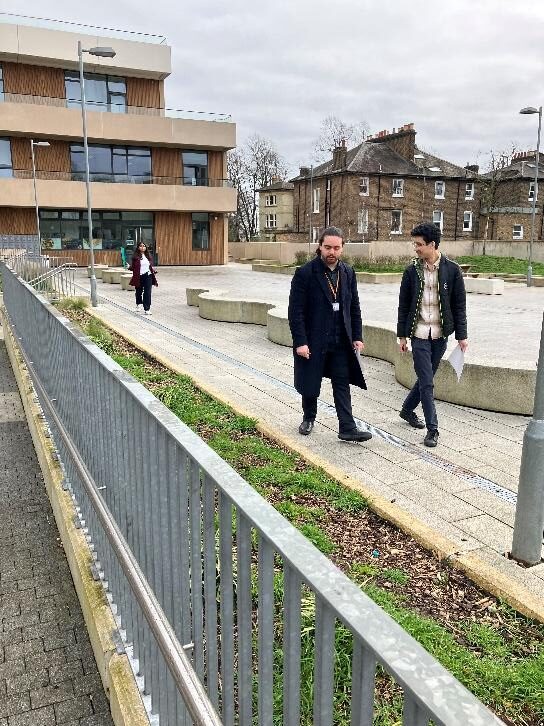
In this lab activity in a school participants changed the environment during the session from indoors to outdoors to write the summary of their findings what they would like to improve in their school environment. While the students that stayed indoors remained much more abstract in their insights, the “outdoor” student had a much wider range of ideas, many of the much more concrete, with one group even coming back with a poem.
Further Suggestions
Moving from one space to another can be particularly interesting if we play with different dimensions. For instance, we can choose a room that is significantly larger than usual, allowing participants to decide where and how they want to gather. We can present a variety of spaces for participants to pick from, even if those spaces are unrelated to the activity itself. For example, why not use a kitchen for a group discussion or bathroom stalls for focused work?
The act of moving can become a space in itself, like a long discussion while walking. Or this might happen in one space, ideally a large room: it is fun to answer questions just by moving around. People can go to different corners to indicate opinions, affinities or qualities. Or they can spread out on a spectrum from pro to con. Even people who wouldn’t usually participate in a discussion will move and show where they stand. It might be nice to interview them afterwards and find out more about why they moved where they did.
Many meetings and even whole conferences have been held while walking. Striding together also keeps people facing the same direction rather than looking at each other. A larger group will tend to break up into smaller groups. We can also think of our practice as a kind of guided tour, with everyone coming together here and there before the walk continues. Smaller groups can discuss as they walk and then come together to share their findings.
Try out different speeds of walking.
The same exercise can then be carried out in a smaller space, where whispering might suffice. Participants in a confined area will behave and think quite differently.
Keep on moving, keep on changing perspective, keep on relating!