Case Study in Brief
Description
This activity invites high school students to use food as a way to tell personal stories, foster collaboration and explore connections between memory, culture and identity. Participants work in teams to create edible, uncooked artistic compositions using selected ingredients. They focus on meaning-making through visual expression, rather than traditional cooking techniques. The aim is to develop students’ creative thinking, collaboration and storytelling by using ingredients as artistic and symbolic tools. The activity integrates science (food properties), art (composition and narrative), and social reflection (identity and heritage), strengthening the link between artistic inquiry and cultural understanding.
Dispatch From the Field
We begin by introducing the SENSE project and the idea of working with food as a form of artistic expression. To help the group connect, we start with a storytelling game using pencils as metaphors. Each participant writes a personal story linked to a pencil, then exchanges it with another. At the end, the pencil stories are compared to their original versions. This playful exercise builds familiarity and sets the tone for sharing and empathy.
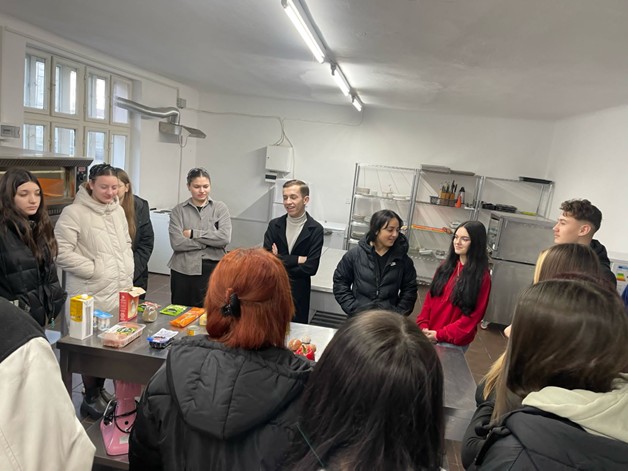
Next, we move into the gastronomy lab where ingredients are already displayed on a table. We encourage participants to explore what each ingredient evokes: memories, feelings, or cultural references. This phase is fully conversational and helps students attach meaning to the raw materials. We facilitate an open discussion, prompting students to speak freely about their connections to the ingredients and how they might reflect parts of their own identity.
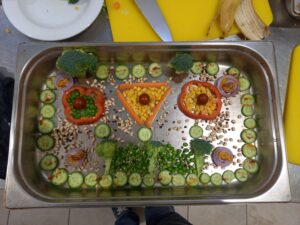
After this shared reflection, we split the group into two teams. Each team takes turns selecting ingredients from the table, making sure that each group ends up with a diverse and balanced set. They then receive a creative prompt: to design a “dish” that represents the group, its members and their shared stories. Importantly, this dish will not be cooked, but arranged and composed visually. The focus is on aesthetic design and narrative.
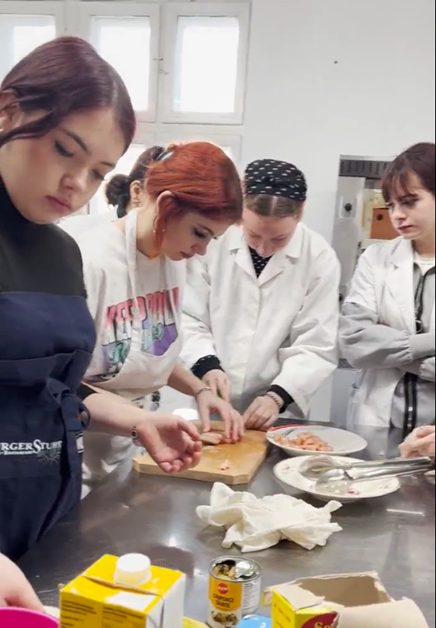
Each team discusses the concept behind their “culinary canvas,” deciding how to combine the ingredients in a way that reflects their story. The making phase is collaborative, and each participant has a task, whether it is arranging ingredients, drawing sketches or shaping the final presentation.
Once the work is complete, each team presents their dish to the others. They explain the story behind it, the choice of ingredients and how their composition reflects group identity. This moment is reflective and celebratory. After the presentations, the teams are invited to eat and enjoy the creations they have made.
This activity promotes group dynamics, active listening and empathy. Through storytelling and sensory exploration, it helps young people reflect on who they are, where they come from and how they connect with others through culture and shared experience.
Practical Details – Facilitator’s Notes
How did you modify the activity?
The activity took 2 hours instead of 1, as participants needed more time to connect and express their stories through food. The added time improved the quality of both discussion and collaboration.
How did you organize the space?
We use a professional gastronomy lab with stations for each team. A central table displays ingredients in a visually engaging way. We create a welcoming setup that allows open conversation, movement and safe food handling. The setting makes it easier for students to immerse themselves in the creative process.
Who did you work with?
We work with students aged 16 to 18 from Lugoj, most of whom are studying gastronomy. They are in their high school first year and have limited practical experience. The activity helps them engage with the subject in a hands-on and imaginative way, giving them confidence and a new way to explore their interests.
What resources did you use?
We use a variety of uncooked ingredients, cutting boards, kitchen tools, plates and sketchpads. We also use printed prompts to guide story creation and encourage creativity. The tools and materials are chosen to support exploration and self-expression.
What did you learn?
Students are more engaged when learning involves both reflection and creativity. Giving them space to lead the activity builds confidence. The combination of storytelling and food creates a safe, inclusive environment. Participants who are usually shy opened up through visual and sensory expression. The structure encourages leadership, mutual respect and co-creation, showing that artistic approaches can enrich technical learning in meaningful ways.