Case Study in Brief
Description
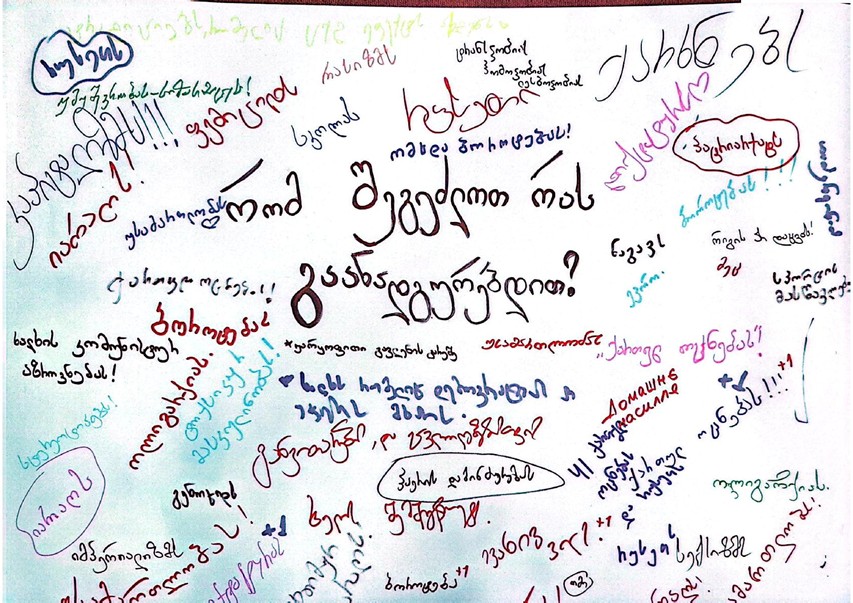
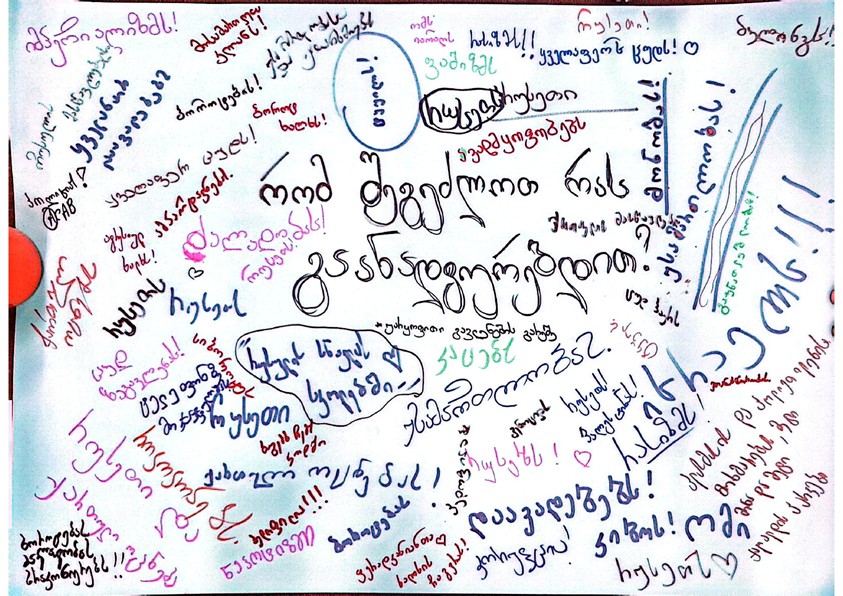
The activity took place during ‘Europe Days’, where WECF Georgia represented the SENSE project in a public event by the European Union. On one of our tables a we positioned an A1 paper with the words “WHAT WOULD YOU LIKE TO DESTROY?” written.
Passers by were invited to write their thoughts on what they would like to destroy.
Dispatch From the Field
The activity took place in ‘Expo Tbilisi’ during the Europe Day on 9the of May, an event organized by the European Union giving different organizations the chance to display their organizations and activities in an interactive and engaging way.
Besides a quiz on STEAM, an A1 paper with the words “WHAT WOULD YOU LIKE TO DESTROY” was displayed at WECF Georgia’s stand on a table. It was written in Georgian. Markers of different colours were available to write.
People were encouraged to reflect about the question and write down their answers.
When more people wrote down their answers, the paper became more interesting, and some participants were reading and discussing answers of previous respondents.
We collected a diversity of wishes of what structures, patterns, regimes, learning approaches were wished for to be destroyed.
Practical Details – Facilitator’s Notes
How did you modify the activity?
The activity was modified to cater to a diverse public that was passing by in an exhibition setting. This way, several hundred people with very diverse backgrounds, age and abilities were able to contribute, reflect on what they would like to destroy and review answers of other participants.
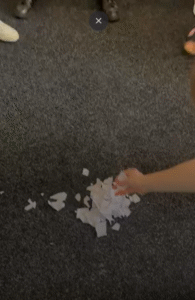
We did not physically destroy any items.
Due to a tense political situation, many people wanted to destroy the current authoritarian political governance. Some children wanted to destroy the educational settings that are not meeting their needs.
How did you organize the space?
The paper was placed on a table at the exhibition space. The space was noisy and not suitable to have verbal interactions with bigger groups. The setting allowed for individual contributions and reflection in smaller groups, while also enabling collective input from hundreds of participants.
Who did you work with?
The event (Europe Days) was targeted at the general public, and widely advertised on (social) media.
In general, the people were young, progressive, opposition minded and opposition minded. Most lived in Tbilisi, where the event took place.
The age range was from 6 years to pensioners age.
What resources did you use?
A1 paper, markers, table.
What did you learn?
The activity worked well in a setting with many random people who passed by in small groups or as individuals. It was engaging and thought provoking.