Case Study in Brief
Description
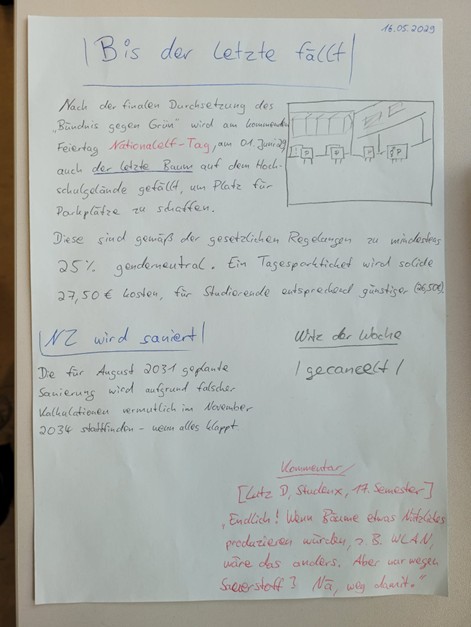
Based on previous engagement with the university campus during the “Favourite Places” activity, the participating students were introduced into the activity “Article from the Future” and tasked to execute it on their own – as homework. While no concrete content and format was predefined, all chose to create a digital version. The articles were presented and discussed in the next in-person meeting of the seminar.
Dispatch From the Field
Preparation / Embedding in a certain space’s qualities
In the previous seminar of the course the university students engaged extensively with the qualities of different spots across the university campus and the science building in particular. While explicitly paying attention to the individuality of sensorial experience and discussing shared expressions as well as drawing conclusions, the students received a follow-up task as homework: The article from the Future.
Preparation / Embedding in a certain space’s qualities
In the previous seminar of the course the university students engaged extensively with the qualities of different spots across the university campus and the science building in particular. While explicitly paying attention to the individuality of sensorial experience and discussing shared expressions as well as drawing conclusions, the students received a follow-up task as homework: The article from the Future.
Task (Introduction)
The students received this instruction:
“Imagine you find yourself five years from now in the future and reading a newspaper article about the place we further investigated – the university’s science building and the area around it or the PHW university campus itself. What could this article look like? What is the headline, what quotes are in it? Pictures, graphics? What changed in the place and what did not? Who is writing?… You are asked to design that article (or cover) from the year 2030. You can do it digitally or on paper/ poster. It is your choice whether your future is optimistic, dystopian, realistic, obscure… be creative and be ready to present your article at our next session!”
Article Creation
As the students worked on their articles asynchronously – in a place/ space and time of their choice – the assignment was more self-regulated in terms of effort they put in (two weeks time overall) and setting they choose for doing their “homework” article.
Sharing Articles
In the next in-person meeting everybody was invited to present their articles. At first the task was recapitulated to highlight that their were close to no boundaries and the results cannot be wrong. Then students presented their different versions by reading out their digital article or showing their papers/ posters around. They were encouraged to explain more about their ideas and illustrations – as well as the design/ format they chose. In between presentations, other students had the opportunity to ask only urgent questions to clarify things that are mandatory for understanding the article, but beneath that no further reflection/ discussion was involved yet – on purpose.
Reflection
Afterwards the participants were told to reflect on the task itself and/or its outcomes (the articles) following these three impetuses to react to/ answer:
- Think of one or two open questions (that cannot be answered with ‘yes’ or ‘no’)
- What would you recommend to an educator that is doing that activity with their course?
- What advice would you give to a participant in that activity?
The answers were written on flashcards, collected by the facilitator and read out loud – to share insights while keeping anonymity. This initiated further discussions about the article contents and the applicability of the activity. So, the reflection was sort of done from both, the perspective of participants and the perspective of potential adopters of the activity.
Practical Details – Facilitator’s Notes
How did you modify the activity?
We did not prepare templates or guiding questions besides the inspiration the task (instruction) serves. The article creation happened autonomously at a self-chosen time and place (in the span of 2 weeks time).
Also, we did not do a voting process as basis for the group reflection but instead reflected on the articles’ content and the activity itself.
How did you organize the space?
During introduction, sharing articles, and reflection we sat in a circle to underline the intention of sharing ideas, products, & opinions rather than having to meet criteria and do a presentation.
The creation of the articles took place in a space of each participant’s choice.
Who did you work with?
Students from Weingarten University of Education that are studying to become (inter alia) physics teachers. All undergrads, all young adults.
What resources did you use?
Surface to show digital articles (laptop + beamer)
Flashcards to collect reflections
What did you learn?
A lack of boundaries (such as concrete instructions) may result in a variety of outcomes (such as very creative articles).