
Citizen Science practices
Scientific knowledge production has been changing across centuries. Initially, we may simplistically assert that scientific production was in the hands of “lords” and “ladies” of science that were amateurs and mostly motivated by curiosity. After the constitution of universities and schools, the XXth century has thus led to an intense professionalisation and institutionalisation of scientific practices where scientists have become experts of very often restricted and limited fields of research.
However, different voices from different places have raised various concerns on the future of scientific knowledge production. In a recent paper in Nature, a marked decline in disruptive science and technology over time is observed and this can be attributed to scientists’ and inventors’ reliance on a narrower set of existing knowledge (Park, Leaney and Funk, 2023).
There are other voices raising the urgent need to address the ethics of inclusion in any scientific practice (Strauss, White and Bierer, 2021). This need may involve the need to build partnerships in science with communities and social groups. For instance, the INVOLVE UK health-research advisory group states “A project that is co-produced is one in which researchers, practitioners and the public together share power and responsibility for the work throughout. The ‘whys’ of this process are self-evident: patients and the public have the right to be more than just participants in research, and their involvement can lead to better outcomes.”1.
From a policy level, the European research policy envisages scientific research oriented by specific societal goals, such as the Sustainable Development Goals (SDG) of the United Nations2. Just for illustrative purposes, a recent report imagines mission-oriented research. The report already includes citizens in this effort stating: “Bold missions can provide new syntheses that are today impossible and thus will hopefully achieve the breakthroughs that are urgently needed to solve some of the most pressing issues facing our citizens.” The report also hints that: “Citizens can possibly be mobilised to become active participants in missions, for example by cleaning plastics from beaches or by providing real-time monitoring data as enabling technologies develop and become more universally present in society.” (EU, 2018).
European Research Executive Agency also supports Open Science which not only favours transparency and accessibility of scientific knowledge but also promotes democratisation of science, knowledge co production or the active involvement of citizens, groups, or communities in scientific research with for instance Citizen Science practices3.
From an epistemological point of view, the term Citizen Science (CS) was originally used during the 1990s with two very different starting points which however can converge. First approach motivates CS as a participatory data gathering (Bonney, 1996) which has multiplied its capacity thanks to the digital revolution of the internet and wide use of mobile phones devices. Alternatively, CS can also be seen as a way to assist the needs and concerns of citizens and as a form of science developed and enacted by citizens themselves (Irwin, 1995).
Sense. adopts an understanding of CS to account for different forms of participation in scientific knowledge production” and “to describe various forms of participatory action research and digital volunteerism, including Community Science, Civic Science, People-Powered Science, Participatory Mapping, Participatory Science, Volunteered Geographic Information (VGI), Community Remote Sensing, Citizen Observatories, Crisis Mapping and Citizen Generated Data […]” (Haklay et al., 2021).
Selected Citizen science aspects of relevance in STEAM education (figure 1):
- a situated knowledge co-production activity, a collective effort where citizens and communities also contribute with their expertise to face a shared concern,
- an actionable knowledge which may drive collective action or policy recommendation based on evidence, and
- an effort which can be harnessed in a wide group of experts and policy makers to favour transformative knowledge.
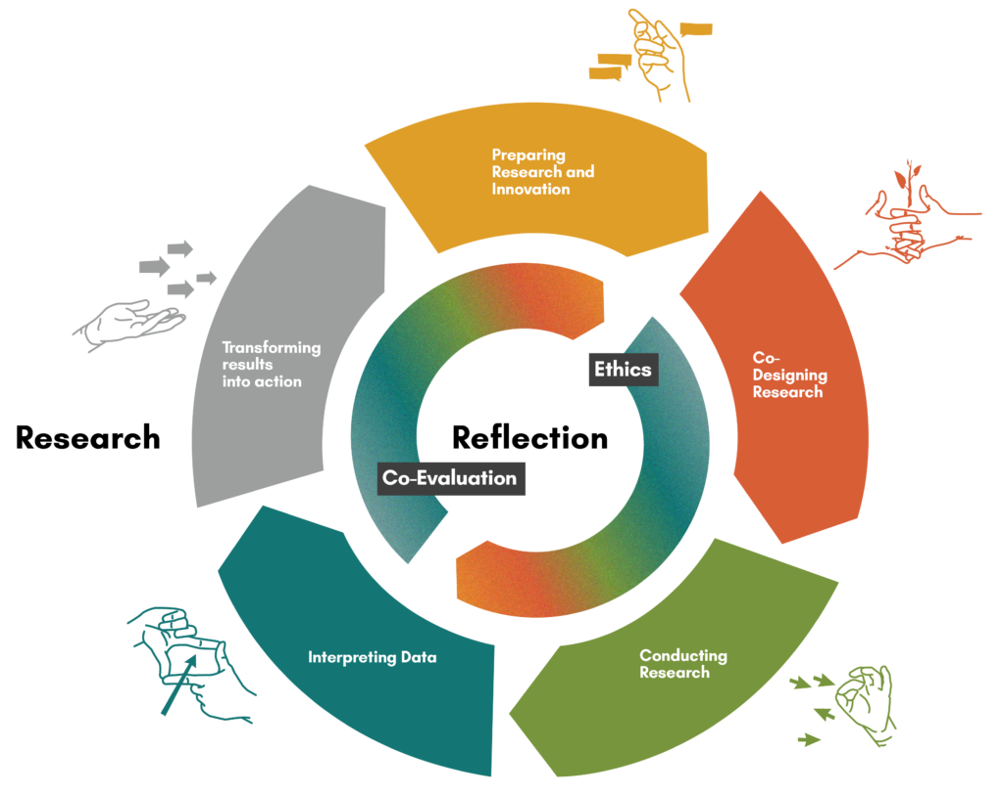
Table 1 identifies three key stakeholders or participants in a CS project: the Co-Researchers, the Citizen Scientists, and the Knowledge Coalition. Figure 8 defines the different phases of a CS project and how participation might be involved in each phase, from the project definition to the final effort to transform results into action.
Finally, Table 2 underlines the ethical values behind any CS project, and which can be comprehended by the SENSE model developed in the Work package 3 and forthcoming Work packages (Work package 6, specially). These values are related to the Social Inclusion cross-cutting issue in the SENSE.STEAM model and it also motivates the need to incorporate co-creation and codesign methodologies when building a CS project, as we will discuss in forthcoming sections.
Actors and stakeholders
| Co-Researchers: persons having a lived experience in relation to the social concerns and thus recognised as experts-in-the-field. They are co-owners of the research data and results. | Citizen Scientists: called for participation through digital platforms in order to collect massive robust scientific evidence to respond to the CoRes concerns. | Knowledge Coalition: network of stakeholders who are informed about the research and play an active role in either participating or co-designing different actions to harness CoRes’ efforts and implement policies and measures based on scientific evidence. |
Values
| Inclusiveness | Horizontality | Equity | Trust | Respect |
| Open Science | Co-ownership | Empowerment | Reflexivity | Reciprocity |