
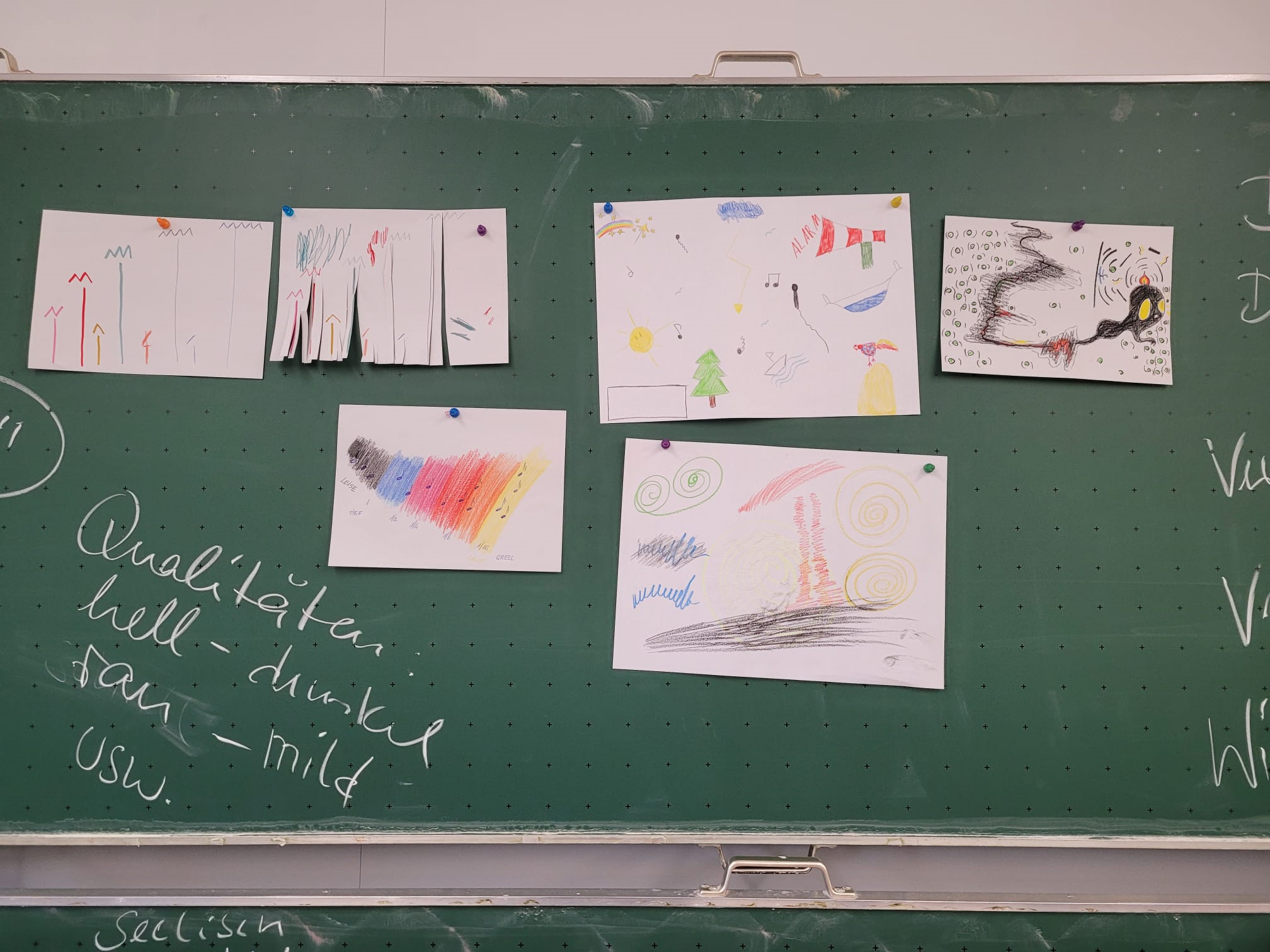
Activity in brief
Participants generate sound from instruments or objects provided. They are instructed to visually represent a variety of sounds they (and others) create. This can happen in the form of a drawing or a painting, possibly even in the form of a poem. Participants are welcome to share their work, their thought processes and how they reached their conclusions. The activity showcases the importance of sounds, our connections to them and different ways of interpreting them.
Detailed instructions
- Spread the materials and tools to create the sounds in the space ahead of participants entering the area. Then let them in. This might induce curiosity.
- Task the participant to create different kinds of sounds with the tools, instruments and materials provided and choose their favorite sound(s) out of that.
- Ask the participants to draw or paint the sound(s) they created, or more broadly: give any kind of visual representation of the sound or the acoustical experience.
- Participants present their sounds and visual representations to the group.
- Participants are invited to share their thought process. Further ideas of how to represent sound can be discussed.
Practical details
Duration
30 to 60 minutes
For Whom
For people of all ages from six upwards, all , professions, genders, languages, cultural or sociological backgrounds. This is a low threshold activity with options to communicate without words.
Participants can work alone or in groups of up to four.
Space requirements
It is very flexible in terms of space. You can be outdoors or indoors. Just make sure everyone feels comfortable and that any destruction from noise or people passing by is kept to a minimum.
Other practicalities
- An alternative task for visually impaired attendees could be to turn a sound into a poem.
- Take care to keep noise to a non-harmful level.
- Be available for questions and supervise the use of materials during the whole activity.
Materials needed
The materials can be chosen freely depending on the context and resources at hand.
- For sounds:
- plastic rulers; rubber bands; strings; threads; wood, nails or screws; tuning fork (with needle); triangle, mallets; pegs; instruments of any kind; tripod with clamps; really whatever is available and can make a sound
- For the visual representation: sheets (papers, posters) in different sizes / shapes / colors,watercolours, pens, pencils, crayons, markers, chalk, charcoal, sand, ink, whiteboard, blackboard, glue-sticks, scissors, thread, stapler, tape, pin needles, paperclips,multimedia (phone, PC, microphone, screens, tablets…), …
Only bring material you are familiar with and are able to handle safely!
Remember that some items are not welcome at specific places, for example some schools don’t allow for scissors or drums.
Recommended Feedback tools
Doing a fast networking activity at the start of the workshop lifts the energy and helps you set the frame. Close the session with a refreshing and crisp round of flashlight feedback. Alternatively, turn the SENSE. manifesto into a card game for a different kind of reflective feedback.
Consider your participants
It is nice to have a variety of objects present, but don’t overdo it as it might be time-consuming or confusing for the group you are working with.
Participants should also be allowed to make depictions of surrounding sounds they did not create on their own.
Connection to SENSE.STEAM
This activity helps participants understand how STEAM education and art might be related. It makes participants aware of their understanding of sound and how sound is related to emotions. This exercise requires participants to actively and deeply listen to the sounds around them, create images that represent those sounds, and embody them in physical form. This process allows participants to recognize how their perceptions of sound may differ or overlap. Through reflection, they may also gain insight into how their senses and mind work.
Please note that this activity is provided for personal educational, informational and convenience purposes only, is general in nature and is not intended as a substitute for professional, legal, or medical advice.