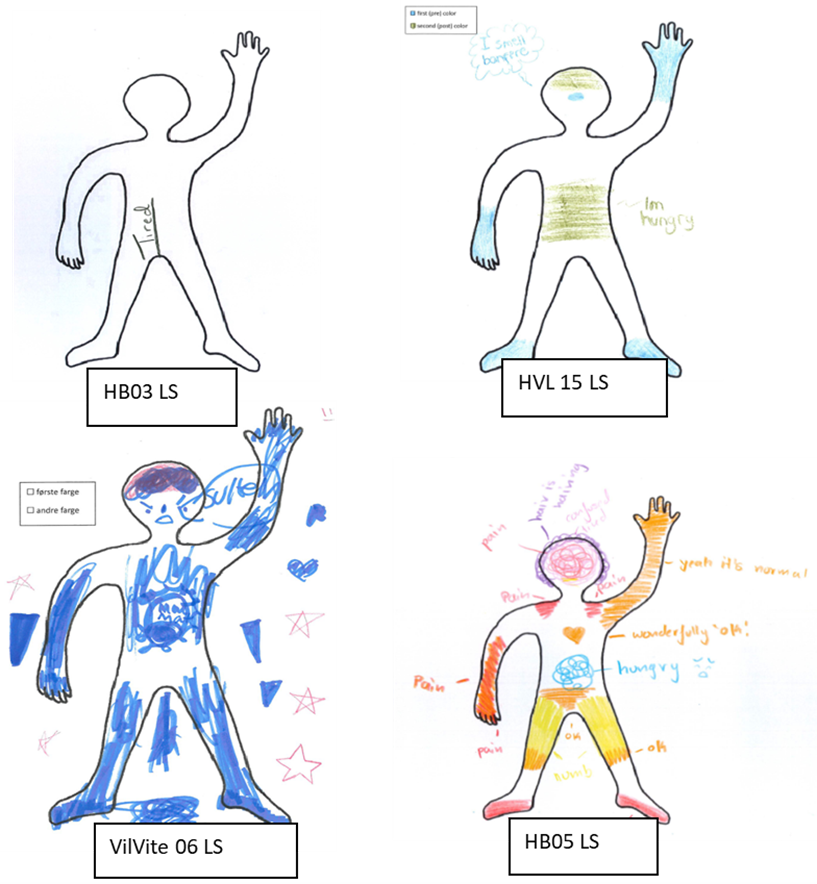
Co-evaluation of educational approaches
Our first exploration of the portrait silhouettes as a method for qualitative evaluation of the impact of SENSE. STEAM Labs came from an article on ‘language portraits’ (LP) “as a research method to investigate the embodied multilingual repertoires of people who use both spoken a signed language” (Kusters and De Meulder, 2019; link to the paper here). The specific image of the portrait silhouette that we use is from Kusters and De Meulder in that paper. They describe the figure as the “abstract gingerbread-man, with little gender-specific details and no clothing, but also not “naked” (e.g., no toes are visible)” (Busch, 2018).
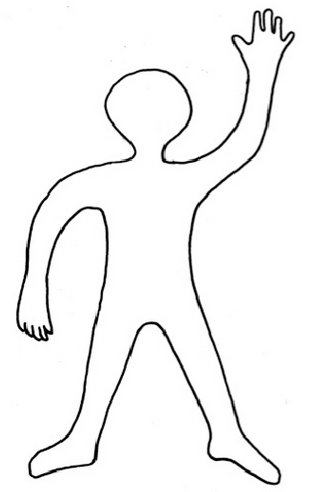
While extensively used and studies across different settings than the SENSE. project – for example in investigating experiences of translingualism (Busch, 2021; Mu et al., 2023) and intercultural communication (Krumm and Jenkins, 2001; Krausneker, 2004) – there were elements of the language portraits that we found useful and relevant to the goals of co-evaluation of the impact of the STEAM Labs, because of the potential of being:
- Multimodal; allowing for the use of vis$ual, symbolic and verbal language together;
- Immediate; it can be understood without the need to translate;
- Versatile; Often used with a combination of methods, such as surveys post-activity;
- Flexible; Used in multiple settings and contexts – schools, teacher training, psychotherapy, contexts including migrant groups, indigenous groups, and more;
- Holistic; The goal is to show embodied experiences and how the present connects with historical and cultural experiences;
- Prompt dependent;
- Explores lived experience.
These characteristics made the choice of method suitable for this project that focuses on diversity of experiences (i.e. gender; cultures; languages; social norms etc) and the importance of the senses to understand how participants may approach their own education, especially with regards to science.