
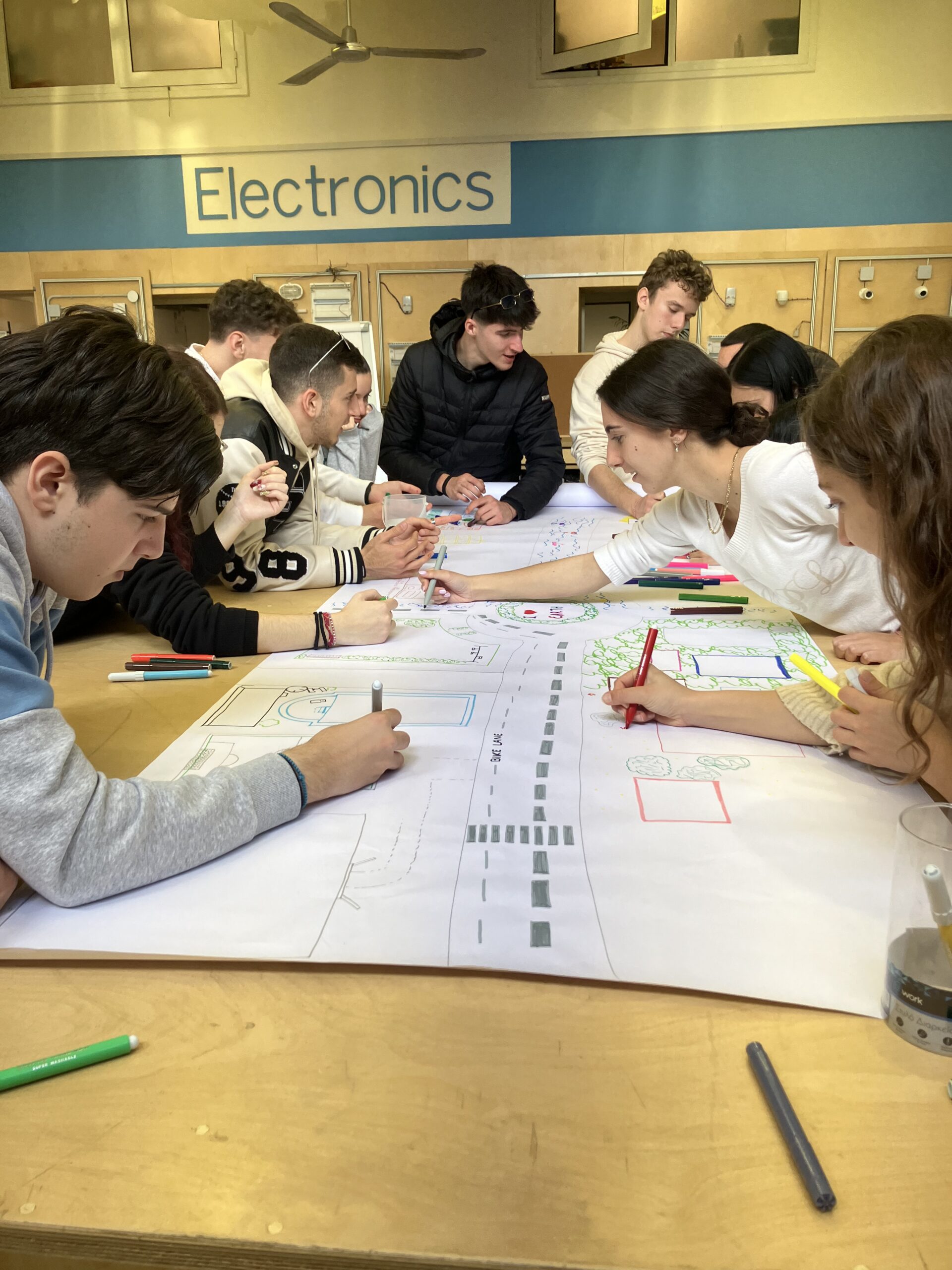

Activity in brief
“Favourite Places” engages participants in identifying and discussing their favorite and least favorite places on a map using colored pins. Participants examine how environments influence their emotions and decisions, but also how community spaces are experienced and perceived by different people. The activity draws together sociology, geography, psychology but also history, ecology and engineering; the aim is to engender dialogue amongst different perspectives.
Detailed instructions
Preparation (5 minutes)
- Prepare a large A2 or A1 basemap of the local area, printed from Open Street Maps or similar, and mount it on cardboard for stability.
- Set up the map on a large table or pin it to a wall accessible for all participants.
Introduction (5 minutes)
- Explain the objective of the activity: to identify and discuss personal connections to various places within the community.
- Introduce the pin colors: one for favorite places and another for least favorite places.
Pin Placement (10 minutes)
- Invite participants to place pins on the map. They can place as many pins as they find practical, with one color indicating “favorite places” and the other “least favorite places.”
- Emphasize that participants should not move others’ pins once placed.
Interactive Discussion (5 minutes)
Encourage participants to engage in conversation either in groups or one-on-one. Facilitators should ask participants about the reasons behind their pin placements, such as “Why did you place your pin here?”
Reflection and Writing (5 minutes)
- Ask each participant to write on a sticky note about a place where they placed a pin. They should note one word, phrase, feeling, idea, or reflection associated with that place, without mentioning their name.
- Attach these notes near the corresponding pins on the map.
Group Discussion and Conclusion (5 minutes)
- Gather all participants to share the sticky notes and discuss the collected data.
- Review the map collectively, discuss the observations made, and share insights about the community’s spatial and emotional landscape.
Practical details
Duration
Between 30’ to 60’ depending on the number of participants involved.
For Whom
This activity is suitable for groups of both children and adults, and it applies to generic audiences (schools, youth groups, adult workshops, and community programs).
Materials needed
- Basemap: A large printed basemap (A2 or A1 size) of the local area, from sources like Open Street Maps, mounted on cardboard for durability.
- Pins: Pins in two different colors (to differentiate between favorite and least favorite places).
- Sticky Notes: Enough sticky notes for participants to write their thoughts and feelings about the places they pin.
- Pens or Pencils: Writing tools for participants to use on sticky notes.
- Large Table: A spacious table to lay out the basemap and allow participants to gather around comfortably.
- Optional Additional Equipment: Wall space or additional boards for hanging the map or displaying sticky notes if not using a table.
Space requirements
- Large Room with a Table: This activity is ideally conducted in a large room with ample space for a big table where participants can easily access and interact with the map.
- Wall Space: Having wall space is beneficial for hanging maps if not using a table, or for placing additional notes and materials.
- Good Lighting: Adequate lighting is crucial to ensure that all participants can clearly see the map and read the sticky notes.
Recommended Feedback tools
Try the fast networking technique to start your workshop, group the answers, and use this summary at the end of the workshop for more thought.
Consider your participants
Spatial Orientation Challenges: Some participants may struggle with interpreting standard maps. Offering alternatives like guided walks around the area or creating personal maps can help those with different spatial thinking skills engage more effectively.
Accuracy of Maps: The provided basemap may not accurately reflect the current layout or may omit significant places that participants feel connected to. This can be an opportunity to discuss the limitations of maps and possibly create a new, more representative basemap with participant input.
Physical Layout Requirements: Ensure a large enough table and room layout that supports easy access for all participants. A larger table not only facilitates gathering and discussion but also supports side conversations and smaller group interactions.
Limited Physical Movement: The original activity may not involve much physical movement, which could limit engagement. Introducing elements such as string or markers to demarcate walks or routes on the map can add a dynamic component, encouraging participants to physically interact with the space and think about their physical relationship with the locations.
Emotional Support: Discussing personal attachments to places can evoke strong emotions, especially if those places are associated with negative experiences. Facilitators should be equipped to handle emotional responses sensitively and provide support or private space if needed.
Keep the Conversation going
Encourage Questions: Regularly pause to invite participants to ask questions or clarify their understanding about the conventions and use of maps.
Invite Personal Stories: Prompt participants to share personal experiences related to extreme environments (like intense heat or cold), helping them to add detail to the maps and their own life experiences
Keep It Moving: If interest or energy drops, introduce new elements like short clips, atmospheric sounds, or sensory prompts to refresh enthusiasm and maintain creative engagement.
Related Case Studies
-
Favourite Places – Community Mapping
STEAM Lab WECFCase Study in Brief Description The activity engages participants from different backgrounds and stakeholder groups to explore the needs and interest of other groups and ... Read more
-
Favourite places – Exhibition
STEAM Lab Pädagogische Hochschule WeingartenCase Study in Brief Description We exhibit a large map of a familiar place in a public space, along with clear instructions on how to ... Read more
-
Favourite Places Mapping in Bucharest
STEAM Lab GEYCCase Study in Brief Description Participants identify and mark their favorite and least favorite local places on a large map using different colored pins. They ... Read more
Please note that this activity is provided for personal educational, informational and convenience purposes only, is general in nature and is not intended as a substitute for professional, legal, or medical advice.