
Activity in brief
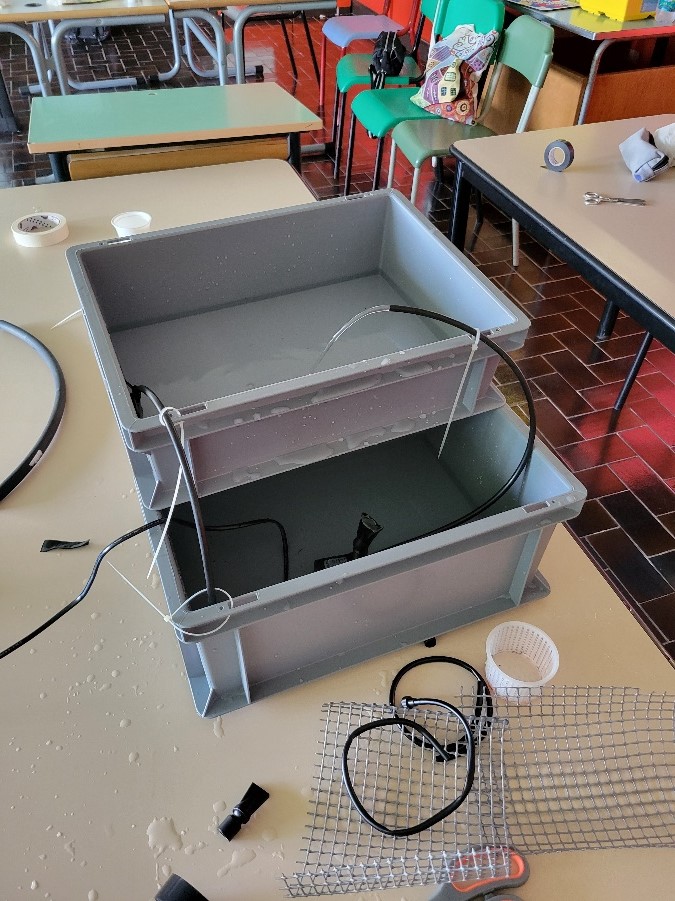
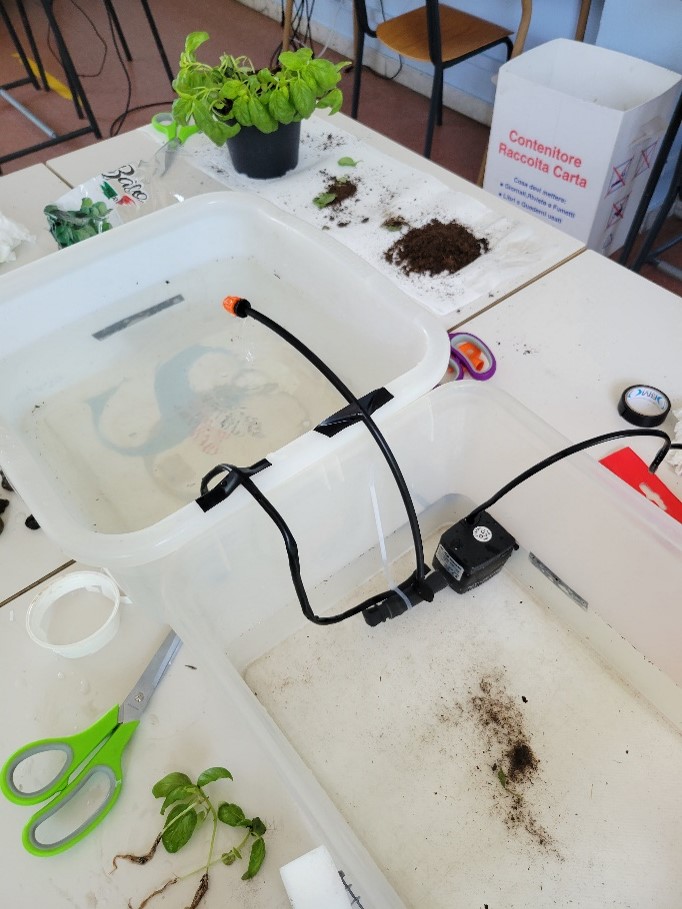
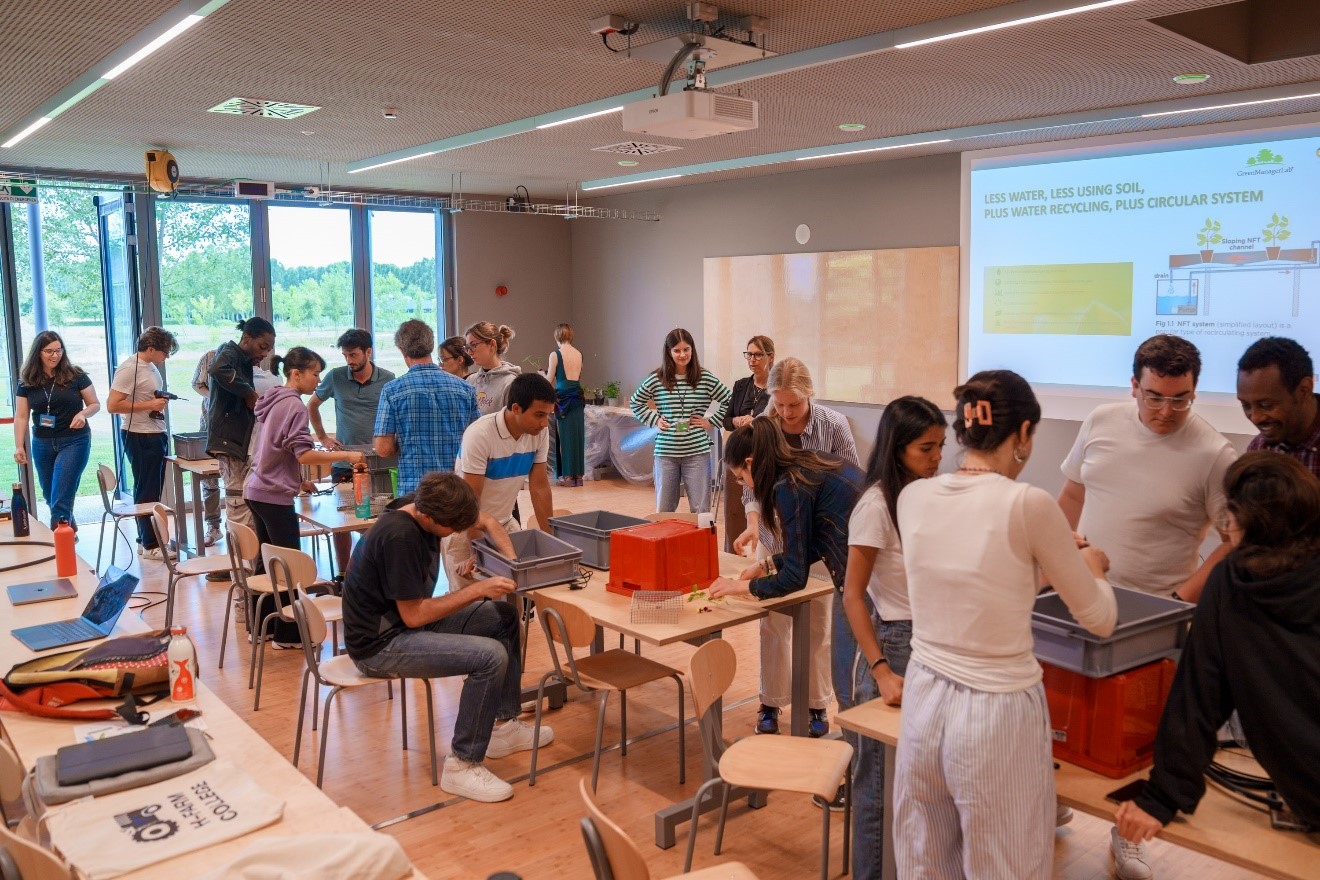
Using basic tools and scrap or second-hand materials, participants experiment with water recirculation, nutrient delivery and plants support structures for a soil-less food production system.
This activity is rooted in designing, making, testing, collaborating with others and receiving feedback to problem-solve, expand design options and iterate improvements. It allows for connections across the sciences, environmental studies and social sciences by opening up discussion on food production, resource efficiency, health and the availability of affordable fresh food in workplaces, schools, and community spaces as well as at home. It emphasizes hands-on, practical learning that connects directly to everyday challenges and solutions.
Detailed instructions
Introduction to agri-food (15 minutes)
The activity begins with an initial moment to enable participants to get to know each other and share initial ideas on the question of food production. This initial part can be facilitated using questions on Mentimeter.
Participants share their ideas on what plants are, what they need to grow, and the impact of intensive agriculture. For example, depending on the workshop’s objective and the group’s interests, the Mentimeter questions can delve into topics such as environmental and economic sustainability (e.g., the potential of vertical farming and soil-less cultivation in urban settings), health (e.g., examining the relationship between daily access to fresh vegetables and well-being), and community space and service design (e.g., how small-scale urban social farming contributes to strengthening communities).
This leads to exploring the benefits of local food production in workplaces, schools, and public spaces.
Jump into hydroponics (30 minutes)
The workspace is set up with different thematic stations, each focusing on a key aspect of hydroponics.
Participants divided into groups rotate between stations, where facilitators introduce and prompt the discussion on specific topics such as available materials and tools for the making session, hydroponics principles, water circulation, essential plant nutrients, vertical farming.
Design and make (90 minutes)
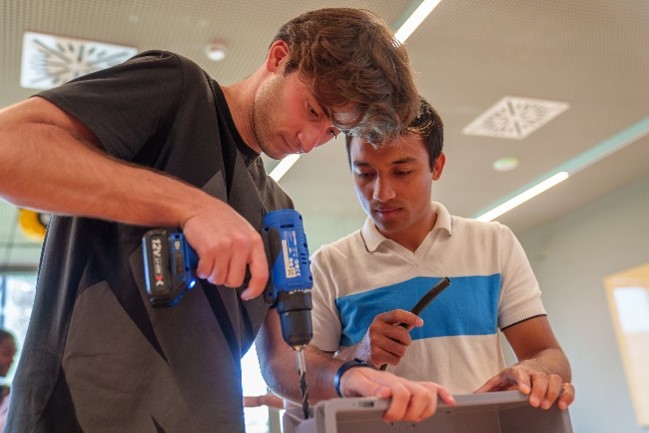
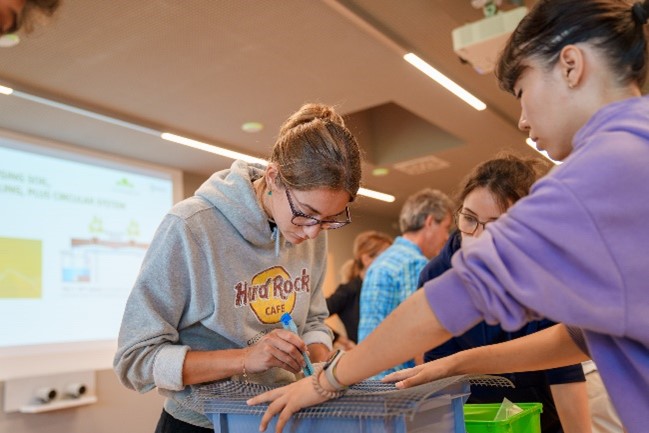
After the exploratory phase, participants design their project and begin constructing their hydroponic system, considering for example how to circulate water efficiently and how to support the plants so that only their roots are submerged. 3. Groups build their hydroponic gardens, making adjustments as they go, testing water flow and stability. Facilitators provide support if necessary.
Tips and adjustments
It is possible to make a system that recirculates water without a pump by using the principle of communicating vessels. In a pump-free design, differences in water levels between interconnected containers create a natural flow that continuously circulates the nutrient solution.
If you want to use a little aquarium pump, it is also possible to power it with a 10W solar panel. If the pump operates at 12V or 5V (USB), choose a panel with the correct output and, if needed, add a voltage regulator. To ensure continuous operation, a rechargeable battery can be integrated.
Sharing models and prototypes (45 minutes)
A gallery walk is organized where groups present their systems, sharing observations, challenges encountered, and solutions adopted. This exchange of ideas and skills allows participants to return to their projects for final improvements. By the end of the workshop, the hydroponic gardens will be ready for use, contributing to food production in the space where they were built or they can be transported to their final destination.
Practical details
Duration
Around 3 hours for the full activity
For Whom
This activity is suitable for young people typically aged 10 and up.
It can be used for workshops in various contexts:
- Community and shared spaces, such as urban gardens and community centers.
- Workplaces, to encourage employees to rethink common areas and introduce healthy, sustainable solutions.
- Policymakers and urban planners, to explore cultivation models in community, urban, and school settings.
Recommended Feedback tools
We found that body mapping and the SENSE. manifesto card game adaptation were very useful ways to give feedback in this activity. The fast networking method would work just as well, when you use it to look at the results again at the end of the workshop and think about it for a moment after the activity.
Space requirements
The activity can be carried out in a classroom, in an open space or outdoor spaces, depending on the available resources. There are no particular requirements except having working tables and access to a nearby water source and a power source.
Materials needed
- Basic tools: drill (manual or electric), scissors, hacksaw, pipes, small tubes, connectors, nets, zip ties, nails, electrical tape, masking tape, packing tape.
- Scrap or second-hand materials, such as cheese, yogurt, and ricotta containers, plastic bottles, or crates to make the hydroponic system.
- Optional: small water pumps, the type for aquarium water recirculation. Consider second-hand or refurbished ones.
- Compost to create a nutrient-rich solution for the plants.
- Organic recycled materials or expanded clay or other to host the plant roots
- Edible plants such as salad greens, parsley, strawberries, basil, arugula, chard, mint, spinach, radishes, cherry tomatoes, and chili peppers, along with other species with a compact root system. If possible, plants can be grown before from seed in a seedbed.
Consider your participants
Inclusivity: The activity allows participants to contribute in different ways depending on their age, abilities, prior knowledge and interests. While the focus is on designing and making the hydroponic structures, the activity can be integrated as part of a wider project focused on food production which expands opportunities for research and wider communication.
Access: Participants may require support with the use of tools.
Adaptability: The activity can be adapted to participants’ abilities by including the option to create a prototype model which may be given to senior pupils in a school or to a group of responsible adults for implementation.
Keep the Conversation going
Encourage Questions: Regularly pause to invite participants to ask questions or clarify their understanding about the topic of food growing and activity instructions.
Invite Personal Stories: Prompt participants to share personal experiences related to extreme environments (like intense heat or cold), helping them make imaginative connections to their hydroponic system.
Keep It Moving: If interest or energy drops, introduce new elements like documentaries and short clips to support inquiry and maintain creative engagement.
Please note that this activity is provided for personal educational, informational and convenience purposes only, is general in nature and is not intended as a substitute for professional, legal, or medical advice.