
Activity in brief
This short activity is about thinking about how people experience the world through their senses and the way their bodies feel. People then express these experiences by drawing pictures of people’s silhouettes. This allows people to explore their experiences in more depth and to communicate these experiences in groups without using words.
Detailed instructions
In this short activity, participants reflect on their sensory and embodied experiences and communicate them via drawing on portrait silhouettes. This allows for both further internal exploration of these experiences and for non-verbal and often non-written communication of these experiences in groups.
This can be run as a before-and-after activity alongside other SENSE learning activities.
Preparation
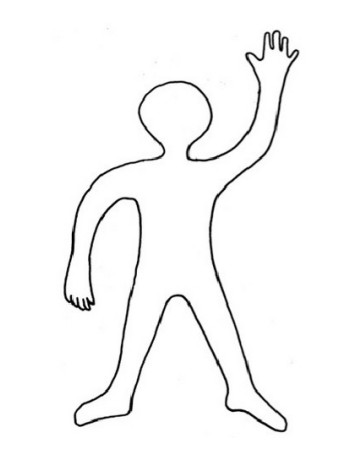
Print out a set of body silhouettes similar to the ones we used in SENSE. (Figure 1) imported from the literature (see (Kusters and De Meulder, 2019). Gather an assortment of pens of different colours. The facilitator can introduce the activity by inviting participants to focus on how they feel in the moment; if they wish, they can close their eyes and take some time to reflect on how they are experience their senses (besides sight) and their bodies.
Development
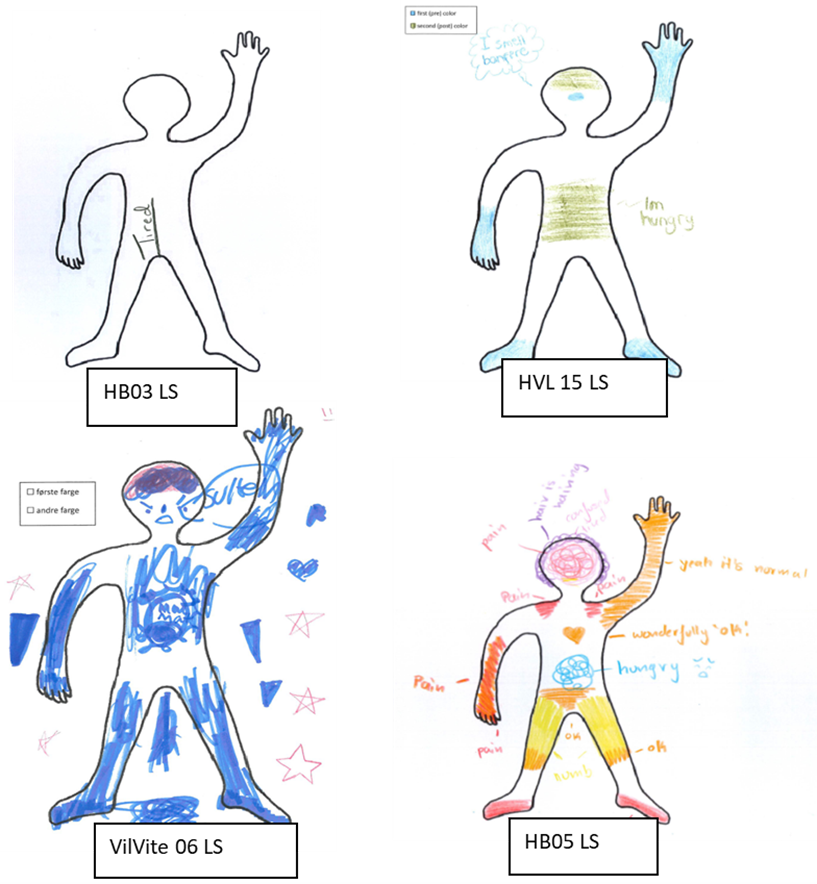
We gave participants the choice of two colours and ask to reflect and draw on the portrait silhouette using one of the colors. This can be for 5-10 minutes. The prompt for this is a general reflection on sensorial experiences using prompts (feel free to adapt):
- How do you feel in this moment?
- Scanning your body sensations from head to toes, what are you perceiving if anything at all?
Encourage your participants to draw in a way that represents those sensations for them. In this activity there is never any one response that is the correct one, but all experiences are legitimate, and the invitation is to create an environment where people feel comfortable to share. This is really essential, as an attitude of openness during this activity.
Collation of portraits
Pin the portraits in a place off to the side so that they can be set aside for the next activity and so that people can find their portraits at the end.
At this point, the activity may end with a gallery walk, and participants can observe each other’s sensations; this may lead to an open discussion about wellbeing in the classroom or in the workplace and an exploration of shared needs. Equally, this initial phase may be preliminary to another SENSE. Activity s part of a sequence which may lead to another set of body portraits tracing sensations post-activity. See next section on further development.
Further development
At the end of any other activities run in the session, participants return to their portraits. Using a different color to differentiate from the before session, participants are given the same prompt to draw their sensory experiences.
Discussion
The group can be led by the facilitator in a reflection on the experience. This may begin with the facilitator asking participants how they found the experience of reflecting on their embodied experiences in this way, sharing stories of what they highlighted. Participants can share if this is appropriate and if they are comfortable.
Possible further expansion of activity: A large group portrait can also be created by the whole class at the end. A life sized portrait can be drawn on the wall and through discussion participants discuss what might have been shared or multiplicity of experiences by the group, and individuals draw those on the life sized portrait. This can be left as a mural in the setting where it was carried out.
Practical details
Duration
10 to 30 minutes
For Whom
It works for any age group and audience.
Materials needed
Printed copies of body outlines or simply blank paper; sticky tape or pins and pens of different colours
Space requirements
It is most comfortably conducted indoors where participants can use tables and walls; however, it is also possible to adapt the activity outside and display the portraits in an improvised gallery on the ground.
Recommended Feedback tools
If you want to keep the feedback short, use a flashlight. As an alternative, you can use the reflection portraits to get feedback. For example, you can ask participants to pass their portrait to the person sitting on the left of them. This way, everyone is invited to continue working on a body map that has already been started. This is a nice way of giving feedback without using words. Repeat the process two or three times. Give clear time limits.
Consider your participants
Sensitive Materials: It is an activity that may generate odd responses with particular groups like teenagers. It is important to establish a climate of collaboration and trust before embarking on this exercise; offer some alternatives to representing their bodies if they so wish – for example they can focus on environmental aspects (lighting; temperature; colour etc) so that people feel comfortable about sharing their drawings in the way that best suits them.
Inclusivity and Access: It can be new or strange for participants to focus on their bodies; some people may feel subconscious; others may feel pain in places or are uncomfortable to talk about themselves and their own bodies. It is important to ensure everybody understands the purpose of the activity is not medical or presentational; it is not about making the best drawing either, but to emphasize this is a way for people to discover how we all experience a place, n environment and a learning activity very differently and how this work helps us to reflect and take care of our individual differences.
Adaptability: This activity can be used for two things: to reflect about how you are doing. And to communicate about how you are doing with other people in the group – without using words. To do this, give everyone taking part a short time limit to start their body portrait. After this time, everyone is asked to pass the portrait on to the next person to their left. Each person continues on a body portrait that already has information from the person sitting next to them. Everyone has to relate to what they can see in the body shape and connect their own feelings and senses to what this person the group has drawn. Repeat this between three and five times. As each portrait is passed down through the generations, it becomes more complex. The more it is passed on, the more detailed and intricate it becomes.
Keep the conversation going
Encourage Questions: Typically, this activity is about questions related to sensory experiences, reflecting on them, evaluating them, and reflecting on one’s own thoughts before and after an activity.
Keep It Moving: Body mapping as an activity has been used extensively in education research and as an educational activity, rooted in the concept of embodied cognition, which posits that knowledge is not merely abstract but is deeply intertwined with sensory and motor experiences. For example, the portrait silhouettes are drawn from work by Brigitta Busch “The language portrait in multilingualism research” (2018) and you can also read further in work by de Jager et al. “Embodied ways of storying the self: A systematic review of body-mapping” (2016).
Please note that this activity is provided for personal educational, informational and convenience purposes only, is general in nature and is not intended as a substitute for professional, legal, or medical advice.