Case Study in Brief
Description
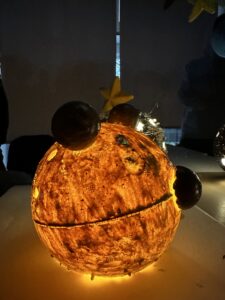
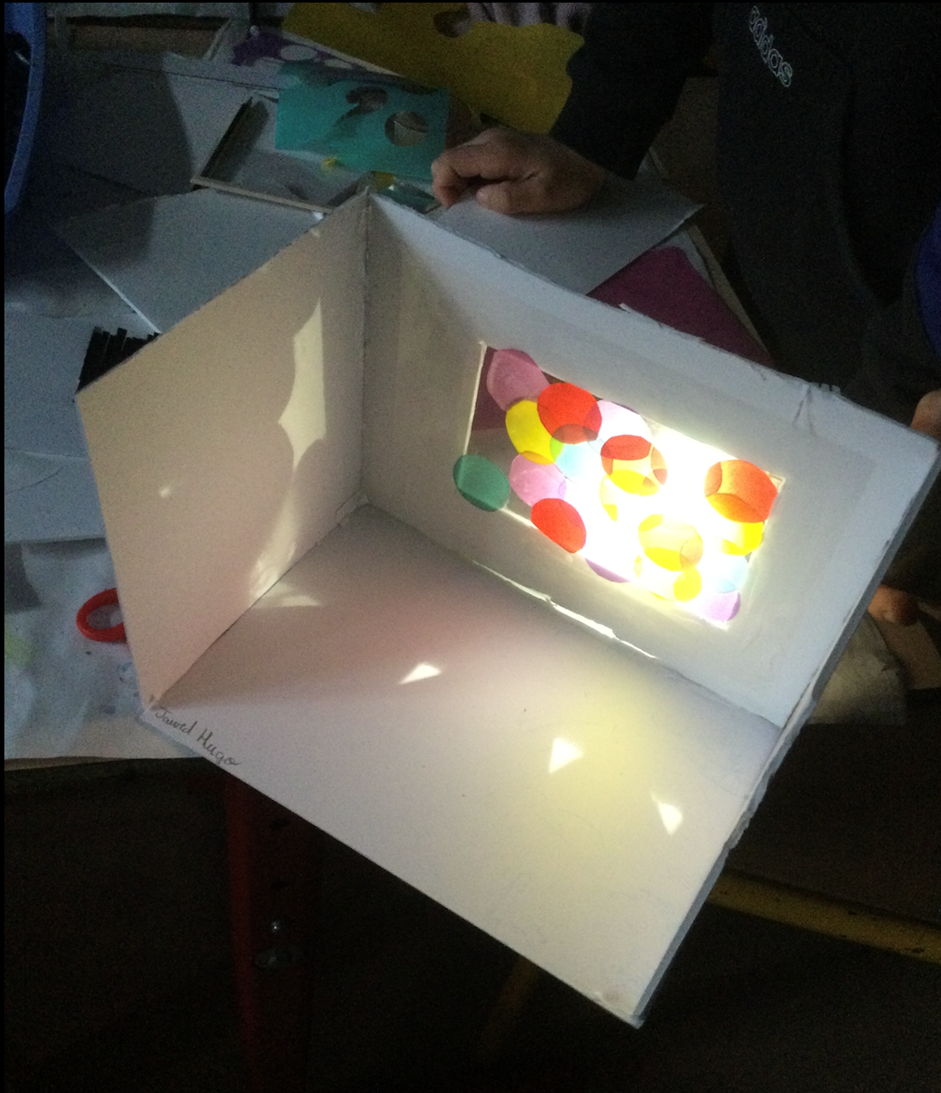
This workshop invites participants to reflect on how light and colour shape different spatial environments and condition our experience of them. Through the design and construction of small-scale models of spaces, participants experiment with different materials based on their behaviour in relation to light: opaque, translucent and transparent. This exploration aims to create luminous environments suitable for different uses and situations, such as learning, relaxation or play. The activity draws on artistic and architectural design references to expand participants’ imaginaries. Creative exploration of visual, material and spatial dimensions fosters awareness of the sensory, functional and symbolic qualities of space.
Dispatch From the Field
This activity follows the implementation of another activity that focuses on techniques and construction principles for creating space models.
1. Introduction:
We facilitators first introduce the pupils to the main questions: How can we use light and colour to transform a space and the experience we have in it? How can light be integrated into a model to enhance its spatial and emotional qualities?
After this introduction, we begin the activity by dividing participants into pairs or groups of no more than three.
2. Visual Inspiration:
to nurture this reflection, we present a series of images to explain the difference between natural and artificial light and to show how light interacts with spaces. We show a selection of artistic and cultural references to stimulate creativity and imagination: from modern paintings to installations by contemporary artists for whom light plays a central role (for example, Olafur Eliasson, James Turrel, or Yayoi Kusama), as well as architectural or decorative elements such as stained-glass windows (vitraux) and mashrabiya (moucharabieh) from the collections of the Musée du Louvre.
Then we introduce the participants to the technical and sensory diversity of materials available and distribute the materials to the groups. This introduction to materials includes a reflection on light as a material and its physical properties.
Participants must choose one type of experiential situation:
- Learning: What kind of lighting is needed to concentrate? What kind of light will keep your attention
- Relaxation and well-being: What light is best for resting? What light makes you feel good?
- Play situation: What light is good for entertainment?
And participants decide on their lighting design accordingly.
3. Planning Lighting Integration and Material Experimentation:
We then give participants time to determine where they will place the openings in their models to let light in. For safety and technical reasons, the facilitators support to make the cuts. Participants take the time to experiment with different materials, their possibilities and their limitations. Some may need to make a preliminary 2D drawing of the design.
A reminder of basic collage and assemblage techniques, as well as possible material actions (folding, overlapping, texturing) and compositional techniques, may be necessary.
4. Finishing the model:
Participants complete the missing construction details on their models before integrating the lighting elements using various materials.
5. Lighting tests:
Once the models are complete, participants carry out various experiments to check how the constructed space reacts to different light sources. The lighting conditions in the room can be modified, for example, by darkening it to use a small torch or different light sources to amplify certain aspects of the lighting design.
6. Group presentation and further reflection:
The participants then place the models their group created on a table so that participants can stand around and observe each group’s work. Each group explains its lighting design project, created based on the situation of their choice (learning, relaxation, and play), and the finished models are discussed collectively. We then open up the discussion to the role of the lighting designers and also to the lighting conditions of other types of familiar spaces (museums, hospitals, schools, etc.).
Practical Details – Facilitator’s Notes
How did you modify the activity?
Duration: 3 hours
This activity is inspired by Bodyclock architecture, with an approach tailored to schoolchildren that focuses on the relationship between space, light and colour, and deliberately excludes the kinetic dimension.
How did you organize the space?
This workshop requires a well-lit indoor space, preferably with natural light, but where the brightness can be adjusted (curtains, blinds) to create different lighting environments and enhance the perception of the devices made by the participants. It is important to have worktables that are large and uncluttered enough to display the variety of materials used.
Who did you work with?
The participants were a group of pupils aged 9-10 from a public school in Paris, accompanied by their art teacher and tutor. The workshop was part of the weekly art classes included in the French National Education programme, which, in Paris, are taught by specialised teachers (mostly professional artists). The thematic focus was developed jointly by the facilitators and the school’s teaching team.
What resources did you use?
The workshop features a wide range of materials for model construction, including foam cardboard (pre-cut bases and elements), various types of paper (white, black, grey, coloured, tracing, metallic, and reflective). Additional materials include balsa wood rods, and cutting tools (scissors, cutters). Adhesives such as liquid glue, glue sticks, and transparent scotch tape are used, along with cutting boards for safety. Materials are organized in flat plastic boxes, and protective sheets are provided to cover the tables.
What did you learn?
The workshop demonstrated how light and colour can shape the perception and function of space. Through model-making using a variety of materials to simulate different lighting effects, participants developed spatial thinking while exploring key architectural and design principles. Drawing on diverse cultural references enriched the creative process, inspiring experimentation with colours, shapes, motifs, and patterns. The activity fostered a deeper understanding of the connection between light, space, and bodily-sensory experience. By combining hands-on practice with reflective exploration, the workshop encouraged active involvement and emphasized light’s potential to shape atmosphere, enhance spatial quality, and influence emotional response.