Case Study in Brief
Description
The Animal Residency activity is mainly a thought experiment happening through discussion. In this application, different members of a sports club were encouraged to think out of the box and creatively reason which animal (or rather group of animals) we could coexist with in our gymnasium. Different ways to contribute were offered, resulting in more engagement than foreseen.
Dispatch From the Field
Introduction
Participants, i.e. different members from a local sports club, were asked to think about an animal (species) they could imagine living close together with, in the space they share: the gymnasium where they train and play their league matches.
We implemented the activity in two different settings:
- At a birthday party where a few members sat together
- Via text (mobile messenger service) as written input/ task, asking for thoughts & ideas
We introduced it using a thought experiment: “Human beings and animals used to live close together. Imagine you were obliged to live close together with an animal or animal species at ‘X’ (name of the gymnasium).”
Brainstorming & Discussion
After the introduction, we scaffolded the discussion through a set of questions designed to focus attention on the local place and the task at hand:
- “Which animal would you choose and why?”
- “What would living in ‘X’ together with this (group) of animals be like?”
- “Think about the space (‘X’): What changes would be necessary to make the co-habitation possibles?”
In the first setting (birthday party) the informality of the space supported sharing of ideas – which were more or less serious, although surprisingly, participants shared suggestions and opinions which led to engaging group discussions.
In the second setting (text messenger), we encouraged participants to share their thoughts and ideas as voicemails of approximately 3-5 minutes. While this modality lacked a collaborative dimension, it resulted into more elaborate reasoning of the cohabitation they had imagined.
The answers were then collected by the facilitator in a template for further reflection.
Sharing & Selection
At the end, all suggestions were shared in a group chat together with a voting for the best suggestion. It was not specified, whether the “best” should be the most realistic, the most creative, or the most elaborate etc. – and members of the group chat (participants, also others) quickly engaged in the voting.
Outcomes
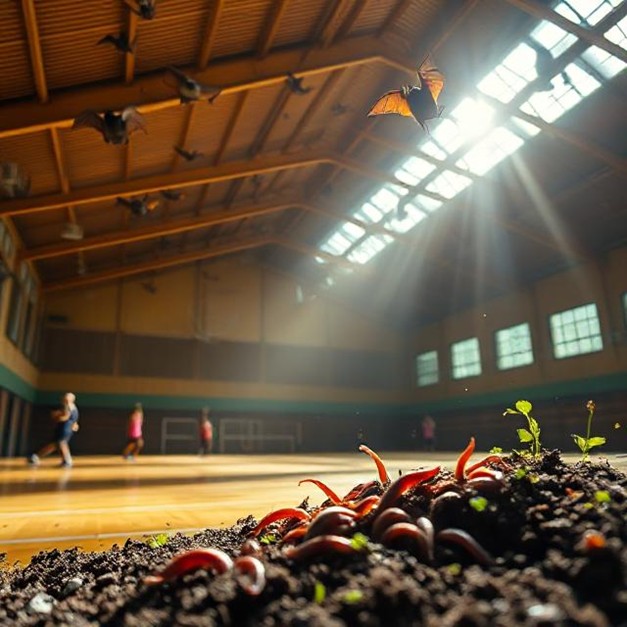
Participants had fun thinking about the shared place in such an unconventional way and engaged more than expected in ideas and discussions. While many different animals were brought up either in person or in the voice messages, the two most favorites were bats and earthworms. While bats could profit from the roof constructions (beams etc.) and the height of the gym, the earthworms were seen as easy to handle by providing a space for them to live in (with soil and water).
Practical Details – Facilitator’s Notes
How did you modify the activity?
As the activity was introduced in 2 settings (in person and via text message), it was split in different parts: contributing at the party or contributing via voice message within the next few days – and, after collecting the ideas, setting up the voting (via group chat) at another occasion. This led to more participation than foreseen.
How did you organize the space?
We worked both in the physical and in the digital space in order to engage different kinds of participants. The physical setting allowed for informal conversations amongst people who were sitting together. The digital setting enabled flexibility through offline contributions.
Who did you work with?
Participants were from a local sports club – and therefore of different ages, professions, backgrounds etc., as they just have in common that they are members of the same club and live in the area.
What resources did you use?
- Template to collect answers.
- Text messenger for direct contact to participants (texts & audios) and for group voting within a group chat.
What did you learn?
This activity, that combines elements of imagination/creativity, citizen science, and thought experiments, can be fun and engaging in non educational contexts as well. Further talks arose about improving the space the members share: “their” gymnasium.