Case Study in Brief
Description
This activity is part-performance/part-story telling happening through the enactment of a residency of imaginary animals in the courtyard of a formal education institution. Participants are invited first to create a small, imaginary creature using a variety of materials and then place the creature in different spaces outside and together consider in what ways the creature (or rather group of creatures) could coexist within the space. Different ways to contribute were offered, resulting in higher levels of creative and personal engagement with the outdoor space.
Dispatch From the Field
Introduction
For this activity we worked with student teachers enrolled in the Postgraduate diploma for Primary Education at the University of Edinburgh. This activity was part of an extended unit dedicated to STEAM with a focus on place and sustainability. Students worked in class where they had access to a variety of different materials (clay, cardboard, playdough, junk modelling etc) to create an imaginary creature.
They took inspiration from drawings produced by the biologist Ernst Haeckel as well as images from various illustrated, popular science books such as “Improbable Botany” (Improbable Botany | Wayward ); “Atlas of Poetic Botany” by Francis Halle’ (Atlas of Poetic Botany )and “Atlas of Poetic Zoology” by Emmanuelle Pouydebat (Atlas of Poetic Zoology).
In this initial phase, students experimented with the variety and flexibility of life-forms engaging the imagination and the different materials to experiment with the unpredictability, the surprises and the idiosyncrasies of evolutionary processes.
Biological science and artistic practice are brought together in the same way through which in the history of science, artists supported the work of scientists in communicating the stories of forms emerging from the paleoethological record and in so doing, feeding into the imagination of the scientists themselves as they made sense of the ‘missing links’ in the genealogy and evolution of life forms in response to changing environments.
Considering the needs of humans and more than human others
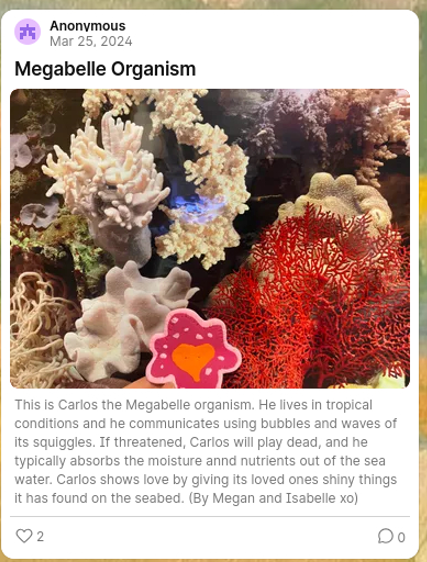
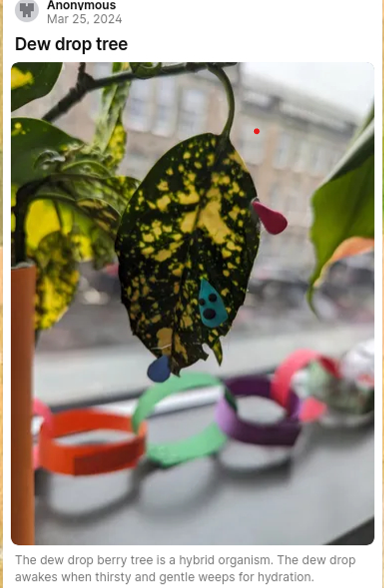
After they made their creature, students were invited to make a profile of its morphological characteristics, food preferences, habits and common habitat; then they were asked to go and find a place for the creature to live outside in the courtyard. Students placed their creations in various and often unexpected places: inside the frame of a window; on top of a bin; in the canopy of a tree; inside an open pipe. Each time they took a picture to document their experiments, including the name of the creature, his/her feelings and a bit of blurb about how the creature would respond, at times, feeling completely at ease in the space; at other times, realizing that the space was not suitable or that they should change/adapt as a result. All pictures were uploaded on a digital Padlet in real time.
Co-habitation
Back in class, we viewed the Padlets and the stories that were progressively told. We used particular questions to elaborate and discuss the different scenarios:
- “How did your creature respond to the environment”?
- “How did they go about finding food?”
- “What would living together with this (group) of creatures be like?”
- “Think about the space: What changes would be necessary to make the co-habitation possibles?”
- What would this mean for people’s lives? What would it mean for the animals’ lives?
While the playfulness of the activity and the informality supported collaboration and sharing of ideas, the discussion in class opened a discussion around wider issues around waste in urban spaces, lack of biodiversity, and equity in the way different groups – humans and more than human – can access a public space.
Outcomes
Participants enjoyed thinking about the space as a place shared with other creatures; and how this method engaged their ability to observe the environment more closely, notice the different affordances and consider the needs and diversity of others. Some students pointed out the benefit of working outdoors and how putting the imaginary creature in a real environment ‘brought them alive’, thus instigating a sense of mystery and adventure, but also a concern for the fate of this ‘other’ than it is not human. Interesting ideas also emerged about the synergies between different species, pointing to the importance of mutuality and interdependence but also how most often we consider other creatures to be at the service of human necessities.
Practical Details – Facilitator’s Notes
How did you modify the activity?
The activity was modified from a thought experiment into a performance role-play which engaged participants more directly.
How did you organize the space?
We worked both indoors and outdoors. The use of Padlet for uploading pictures required internet access.
Who did you work with?
We worked with 120 students in Higher Education studying for the Diploma in Primary Education.
What resources did you use?
A mix of clay modelling, playdough, junk modelling; digital padlet interface; students had access to their own personal phones for taking pictures.
What did you learn?
This activity combines elements of imagination/creativity, citizen science, and thought experiments. Students readily understood the wider purpose of the activity and how it can be used to engage people in philosophical discussions around environmental issues and the rights of nature. Further talks arose about improving the space outside for educational and recreational purposes.