Case Study in Brief
Description
We co-designed this sequence with preschool and early primary school teachers, focusing on how light interacts with objects. It encourages children to explore and ask questions about how natural and artificial light sources create shadows.
Dispatch From the Field
The activity begins with reading an illustrated book in which the protagonist’s shadow looks like a duck or a rabbit depending on their adventures. Can we change our own shadows as the story’s hero does?
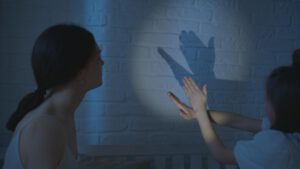
- To explore this question, we prepare a cut-out of the book’s character and give each pair of children an LED flashlight to project the duck/rabbit silhouette and their own shadows onto various surfaces around the room. As they play with their bodies and the light, they discover how the size, shape and angle of the light source affect the shadow they see.
- Building on these first insights, the children experiment with an assortment of everyday materials: reflective sheets, light-diffusing or -bending objects, opaque or perforated items and transparent coloured gels.
- Next, they create their own “mischievous shadow stories,” just like in the book we read. Working in small groups, they build a “shadow box” – a miniature theatre made by replacing one side of a cardboard box with baking paper. Using tape and sticks, they design and position characters inside the box, then shine their flashlights to project their narratives onto the translucent screen. Afterwards, they share their stories and discuss what makes a shadow.
- Do shadows only appear when we use a torch? The children explore the school garden, tracking down every shadow they can hunt and investigating how it forms.
- Bringing both the indoor materials and found objects like leaves and berries outside, they experiment with sunlight and capture sharp or blurred shadows on plain white paper
- Finally, the children draw their shadows, tracing the outlines they see on paper. We then revisit those drawings later in the day to see how the shadow’s shape has changed and reflect on what that teaches us about light, position and time.
Practical Details – Facilitator’s Notes
How did you modify the activity?
This sequence takes more time, with two sessions of two hours each, one indoors and one outdoors. It gives children time to explore materials at their own pace, play with shadows in both settings and share what they discover. We begin with a story where light and shadow play key roles, then we invite children to document their explorations by creating new shadow stories of their own.
How did you organize the space?
At first, we use the classroom without making it especially dark. Since torches create strong shadows, a dark room isn’t necessary. White walls aren’t required either. Every surface, from the floor to tabletops, can create surprising and interesting shadows. For the outdoor session, we choose a space that allows free movement and open-ended exploration.
Who did you work with?
We test this sequence with groups of children from both preschool and the first two years of primary school.
What resources did you use?
- An illustrated story about shadows and light, and a cut-out of the book’s character to explore their shadow
- LED flashlights
- Everyday materials and objects (reflective, transparent, perforated, etc.)
- Paper and pencils
- Tape and sticks
- Cardboard boxes (shoeboxes work perfectly)
- Baking paper and glue
What did you learn?
This piloted sequence shows how important it is to give children time and space to explore. We observe how their curiosity naturally leads their investigations. Both indoor and outdoor settings are essential, and waiting for a sunny day makes a big difference when comparing natural light with artificial sources.