Case Study in Brief
Description
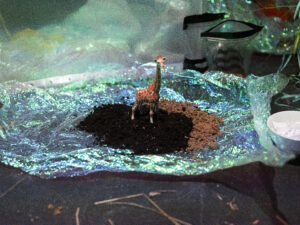
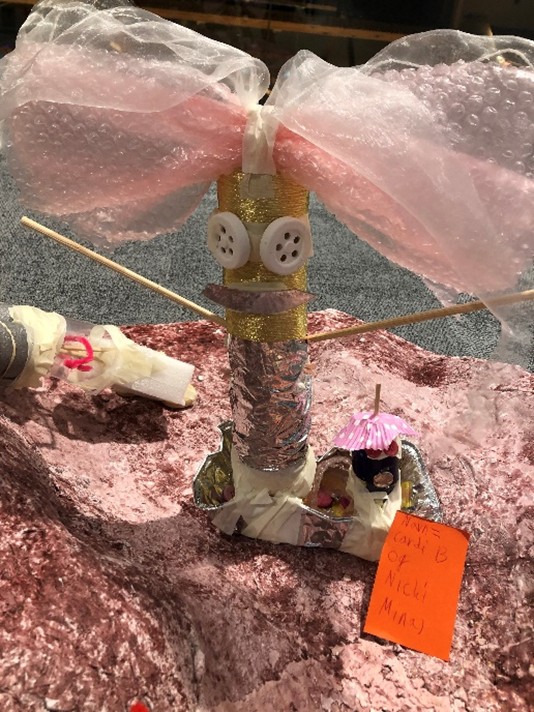
During one week at the Vilvite Science center in Bergen, 10 school classes of children aged 13-16 participated the extraterrestrial life activity (60 min). The main objective in this activity was to reflect and imagine how the conditions are on the rocky planet Mars, the gas planet Venus and the icy moon Europa. The participants were asked to make a creature that could survive on the planet or moon, and were specifically asked to think about how the creature eat, move, and protect itself from the conditions. Physical installations of Mars, Venus and Europa were displayed in the room, ready for the creatures to move in to.
Dispatch From the Field
Introduction
The whole group were gathered outside the door to the dedicated room. Two staff members of the science center introduced themselves and gave some short information about the SENSE.STEAM project. Next the students got instruction for the first part of the sequence (portrait part 1). Writing pads with a sheet of a body portrait were handed out to each students and they were told to find a seat each when entering the room.
Entering the room
The atmosphere in the room was set with relaxing music and dimmed light. Single chairs were spread out in the room, and the students were asked to find a free chair. The music was tuned down, and further information was given for the first task (portrait part 1). After the instruction, music was turned up again and the students worked individually.
Portrait part 1
During 1,5 min the students were using a red colored pen to draw on the portrait how they felt their body today. How did the different part of their body feel, e.g. back, fingers, heart, head? The portrait was put in an envelope with a unique sticker they were asked to memorize. Envelops were handed in.
Introduction to the planets and moon
A PowerPoint presentation were given, first describing our planet earth and the conditions we have for life, next the focus was directed to other planets and extraterrestrial life. How are the conditions at Mars, Venus and Europa? Is it warm or cold, is it solid ground or gas, is it stormy og calm? The students were introduced to today’s mission to make a creature that could survive on the dedicated extraterrestrial planet or moon. Around on the walls it was posted 5 A3-page descriptions of Mars, Venus and Europa (total 15). Each information Sheet was also given a number (Mars 1, Mars 2, Mars 3..)
Organizing pairs to work together
Each students picked a card with a combination of a planet/moon and a number. Each card was made in duplicates. The students were instructed to go to information sheet with the same combination of planet/moon and number to meet their partner. Next, they took the information sheet down, went to sit down on the big table dedicated for the planet/moon and started to highlight important text information on the sheet with a marker pen.
Make a creature
Crafty things were provided on the table, and the pair was free to use the material they wanted to make the creature. They were told it was important to consider the conditions on the planet or moon, and they were specifically asked to think about how the creature eat, move, and protect itself from the conditions.
ID cards
After the creatures were made each pair was given a ID card to give a name to the creature to be displayed at the exhibition.
Exhibition
The pair first presented the creature to the other pairs within the same planet or moon.
Next, the music was turned up to get everyone’s attention and the students were told to go to the installation of their planet or moon to place down the figure. For the exhibition, everyone listed to each planet/moon group presenting all 4-5 creatures.
Portrait part 2
The students were asked to repeat what they did in portrait part 1, but this time use a blue pen. The students collected the envelope themselves with the unique sticker, and sat down on a chair working for 2.5 min individually before handing the envelope in.
Entering the room
Practical Details – Facilitator’s Notes
How did you modify the activity?
This activity had a short time frame (60 min) which also included the evaluation tool body portrait. By having restricted time, all steps had to be quick and efficient. It was helpful to use music or light dimmed up or down to gather the student or switch focus.
Also, by making random groups, the students met their partner at the dedicated information sheet. This may have resulted in less question about switch partner.
How did you organize the space?
The room was organized with 3 big group tables, one for Mars, one for Venus and one for Europa. Each table had a mix of craft equipment provided. When the students entered the room, single chairs were spread out in the room to make a nice setting for individual work for body portrait part 1. The chairs were later used around the big tables. Installations on the planets and moons were also displayed in the rom. Mars and Europa were on the floor (approx. 1.5 x 1.5 m) while Jupiter was hinging (a hola hoop covered in foil).
Who did you work with?
The students were at junior high school level (age 13-16). They were invited to take part in the activity. This was an isolated event for them, not necessarily connected to their current curriculum.
What resources did you use?
Resources for the extraterrestrial life activity:
- PowerPoint with description of task, music.
- Cards to write the name of their creation.
- Material to make creatures with
- Tape
- Coloured pencils or markers
- A3 description of planets (5 of each, depending on group size)
- Highlighters
- Planet cards for making groups.
- Exhibition space for Jupiter, Mars and Europa
Resources for body portrait:
- Writing pads
- 32 sheets of paper with body print
- 32 red pencils/markers (first colour)
- 32 blue pencils/markers (second colour)
What did you learn?
The staff learned it was good to calm the students with music and dimmed light to create an atmosphere. They also experienced 60 min was too short and they would benefit from a longer time frame. They also noted it would be better if the activity fitted the current curriculum for the students.