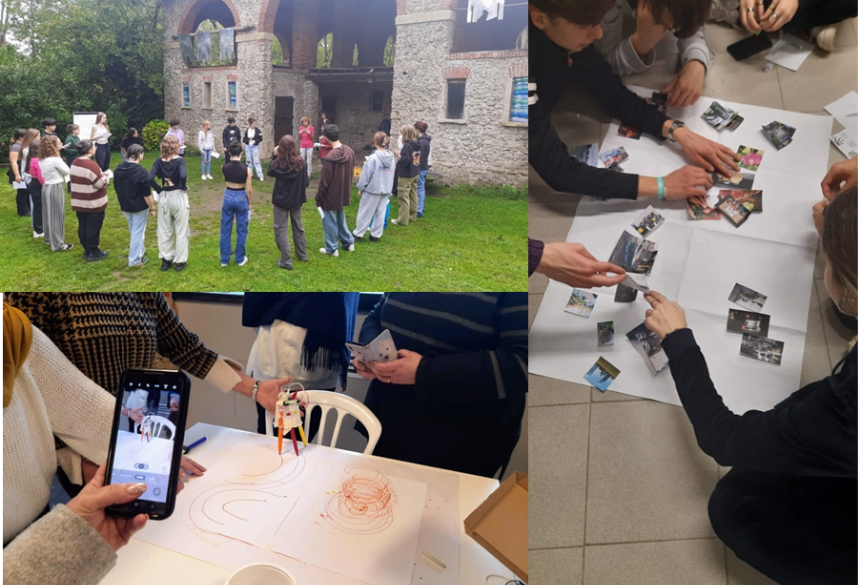
The partners in Italy, Spain, Scotland and Norway (Creda in Italy, HVL/UEdin in the UK and UB/Bofill) had one thing in common: the desire to contribute to a kind of science education, that values and includes a variety of perspectives. One, that engages emotions, senses and the body and focuses on addressing real-world issues, such as food security, heat and climate change in practical, imaginative and experiential ways. In this portraiture the key theme is “acting as if…”, that is the drive for turning everyday spaces and activities into artistic actions to enact desired futures. For example, for CREDA (Italy), activities outdoors engaged the senses and led to the amplification of voices that were silent in the classroom but were heard in nature. Activities involving design, and scenography set ups raised awareness of participants’ abilities to create and craft something of their own initiative.
Imaginative Capabilities in Italy
CREDA organised a series of events held in different locations – public park, public exhibitions and the local environmental education centre – aiming to involve the wider public, groups of young people but also teachers and business professionals. STEAM comes across as a discourse of opportunity to reclaim agency through imaginative capabilities and re-engage with educational practices that support social interaction and wellbeing to address common concerns around climate change. MAKING with natural materials and PHOTOVOICE act as powerful mediators between the cognitive and sensorial/aesthetic domains. However, there is also a recognition of how elements of actual co-production may be difficult to implement as they require greater collaboration and a very different use of the spaces available in schools.
Gardening in Scotland
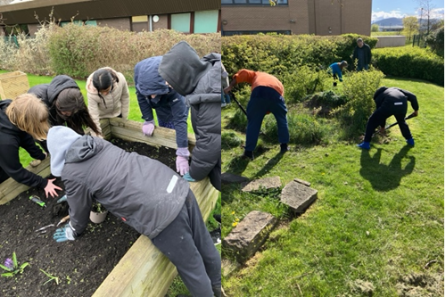
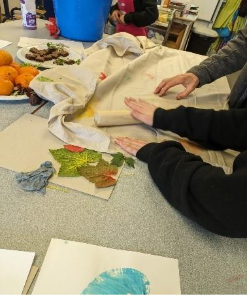
Similarly, for the University of Edinburgh (UK), two educational researchers worked alongside the class teacher and met with the girls’ class over 12 sessions from October 2023 to April 2024 and in this time the participants explored themes of sensing, making through ancient crafts, soil painting, gardening, planning, cooking and sharing with community. Analysis of activity reports show that participants were able to get a very rich experience of the garden as an integral space to their being educated at school from participating in the SENSE. educational approach over this long period of time.
The garden space that often sits at the back of the school and it is largely disconnected from curriculum planning offered the girls a place to be and meet themselves as well as other creatures (the mouse that lived secretly under the bushes and delighted itself with the rubbish left behind), a place to move and co-design; and a place to care for themselves and others. And so is the Home Economics base that is not simply training to cook but a space to imagine oneself as a character in a story; a maker of artefacts and a maker of social worlds.
Citizen Science in Barcelona
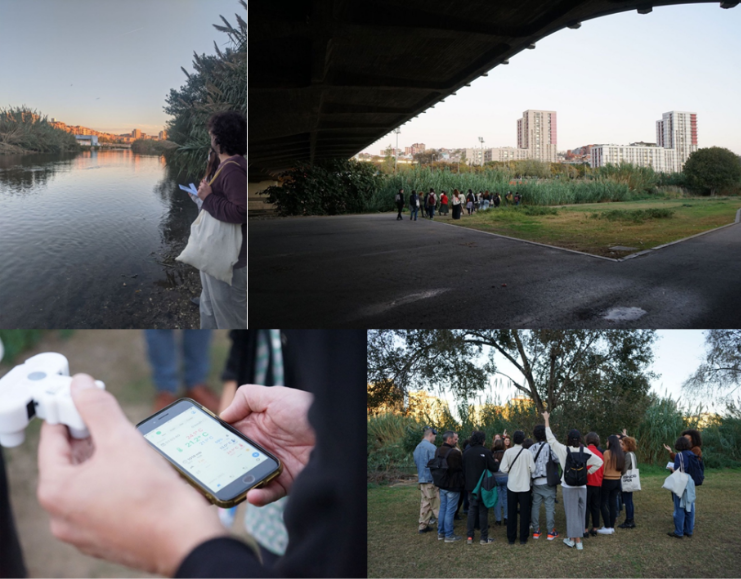
For University of Barcelona/Bofill engagement in citizen science activities appeared to further accentuate a configuration of STEAM for social inclusion, participation and conscientization of matters that affect communities directly. Embodied perceptions of heat were engaged as a means to reflect on wellbeing an ability to perceive the environment (i.e., the river) differently through a closer contact/direct experience; however, there are questions around how to combine aesthetic/personal observations with data for policy-makers.