

Case Study in Brief
Description
Participants identify and mark their favorite and least favorite local places on a large map using different colored pins. They then share the feelings or memories connected to those spots through a guided discussion and by adding anonymous sticky notes directly on the map.
This activity combines geography and social science with personal reflection. Its purpose is to explore how physical environments shape emotions and decisions.
Our STEAM goal is to encourage spatial and critical thinking. Participants draw on sociology, psychology and mapping as they reflect on their community. The activity opens space for multiple perspectives and helps participants see their city in new ways.
Dispatch From the Field
We conduct this activity as an interactive mapping workshop within a future-making framework. It invites participants to explore their personal connection to the city, both in the present and in an imagined future.
We begin by introducing the SENSE project and key STEAM concepts. Participants express their initial emotions by placing red marks on a wall, then repeat the exercise in blue at the end of the session to reflect emotional changes.
To build group connection, we use a storytelling game. Participants exchange personal narratives using pencils as prompts, highlighting how stories evolve through shared experience.
Next, participants discuss both the current and the future states of their city in two separate thematic groups. They share reflections to build a shared understanding of local spaces.
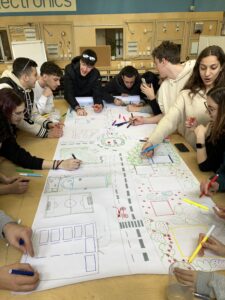
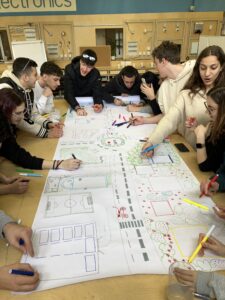
We mount a large printed map of the city on cardboard and give participants colored pins. They place yellow pins where they have positive memories and purple pins where they associate negative experiences. This sparks conversation about personal experiences and differing views, showing how people feel contrasting emotions about the same places. Anonymous sticky notes let participants express feelings and memories linked to specific locations. These notes add more depth to the discussion and allow honest reflection. These conversations reveal important insights about parts of the city that are often stigmatized or overlooked. Participants begin to recognize how personal narratives can reinforce stereotypes and influence how communities invest in or avoid certain spaces.
The future-making element encourages participants to imagine positive change. It connects STEAM methods with real-world decision-making and social awareness.
This approach shows both participants and educators that STEAM is not limited to formal lessons. It can take shape in practical, reflective and creative activities that help shape community futures.
Practical Details – Facilitator’s Notes
How did you modify the activity?
The mapping activity takes about 60 minutes with our group. We follow the original timeline, which suggests 30 to 60 minutes, and choose the longer option to allow for deeper discussion.
We keep the structure of the activity the same but give participants extra time to talk about patterns that emerge on the map.
This small extension proves valuable. The group’s enthusiasm leads to longer conversations, and the added time makes the experience more meaningful.
How did you organize the space?
We hold the session in a spacious indoor room with a large table at the center. We place the city map, about A1 size, on the table so participants can walk around and reach all sides. This setup encourages movement and lets everyone place pins comfortably.
We also use the wall space. After the first round of pin placement, we tape the map to the wall to read the sticky notes aloud. This way, the whole group can see the map clearly during the final discussion.
The room setup allows everyone to gather around the map and creates an informal, collaborative atmosphere.
Who did you work with?
The group includes about 15 participants, mostly high-school-aged young people from different neighborhoods across the city. A few educators also join out of interest. Participants come from diverse socio-economic backgrounds and represent different genders, and some have not met before. Despite these differences, everyone engages eagerly in the mapping activity.
Educators, including local teachers and research facilitators, take part without affecting the group dynamic. All participants contribute equally, and the range of backgrounds leads to a rich exchange of views about the city.
We notice that not everyone shares the same local references. Sometimes, one participant’s story or comment about a specific area needs extra explanation for the rest of the group. In future sessions, we may consider grouping participants from similar areas to help them relate more easily. Still, we find that the group’s diversity adds real value to the experience.
What resources did you use?
Large printed map of the area: We use a detailed city map, approximately A1 size, printed from an open-source map service. We mount it on cardboard to keep it flat and easy to move.
Colored pins: We provide two distinct colors of push pins, green and red, for marking favorite and least favorite places.
Sticky notes and pens: Participants use small sticky notes to write a word or feeling linked to specific locations. We supply regular pens or fine-tip markers for writing.
Markers and tape: We keep a few markers available to label parts of the map or wall if needed, and we use tape to secure the map to the wall during the discussion.
What did you learn?
Many participants begin the session with a negative bias toward their city. They focus first on what feels wrong or unattractive. As the session continues, they start to uncover personal memories and meaningful connections tied to those same places. By the end, they develop a more balanced view of their environment. This shift shows how even a simple mapping activity can reshape how people see their surroundings.
Words matter. Participants notice that calling neighborhoods “dangerous” or “boring,” even in passing, can reinforce negative stereotypes. These words shape how others view and treat those areas.
The group’s diversity brings depth to the discussion. Still, we see that stories about familiar places spark more immediate connection. For future sessions, we may provide more background or group participants based on how well they know certain areas.
We also learn to explain the STEAM value of the activity more clearly.
Some educators don’t immediately see the scientific or analytical aspects. Once we point out the use of spatial thinking, personal data and critical reflection, they understand. STEAM can include social insight, not just technology or formulas. This reminder helps everyone see the full learning potential of the activity.
Related Case Studies
-
Mapping Favourite Places
Activity in brief “Favourite Places” engages participants in identifying and discussing their favorite and least favorite places on a map using colored pins. Participants examine ... Read more
-
Favourite Places
Activity in brief “Favourite Places” engages participants in identifying and discussing their favorite and least favorite places on a map using colored pins. Participants examine ... Read more