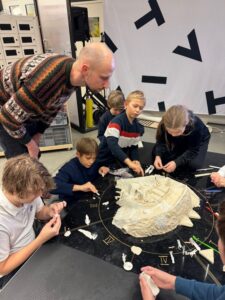
Case Study in Brief
This activity engages participants with making and designing, two complementary dimensions of the creative process. While making invites a responsive and attentional attitude to the materials in an open-ended exploration, design engages intentionality and purpose directed towards a goal. Both processes engage with materials in the old-age dichotomy between aesthetic and functionality, leisure and work which characterise Western Modern Thought. Through the combined exploration of making and design, this activity invites a reflection on the creative interplay of potentialities and limitations and it is used as a live metaphor to reflect with teachers on the work of education.
Dispatch from in the Field
This activity is best presented as an open task, for which there is no right or wrong answer and no requirement to come up with the best model or solution.
We tried it during a professional development course with a mixed group of teachers from different settings. The purpose was to reflect on what it means to engage in curriculum-making as opposed to curriculum design by working with materials. In this way we were able to give meanings to potentially conflicting ideas through concrete experiences which could be observed and shared with others.
Participants were given three sets of materials: play-goh; lego blocks and clay.
With the first set of instructions they were invited to ‘make a man with a leg standing up’; they could choose which materials they wished to use and they were encouraged to try them all in order to compare the different experiences and they responded to the affordances and characteristics of the different materials. The task was left deliberately open to allow personal interpretations as well as make personal choices about how to make use of the materials.
In the second phase of the activity, we asked participants to work in pairs; in silence they were invited to work together on making a clay figure each time by modifying and changing parts until they felt satisfied with the final product, at which point they could stop.
Reflections from the Facilitator
How did you modify the activity to suit your needs?
This activity lasted about 45 minutes in total. The main change we introduced was to relate the making process not simply to learning about engineering or technology but reflect more widely on the educational process. We used it as a metaphor to allow participants to reflect on themselves, for example on how they were able to listen to others as well as to themselves; to communicate positive and potentially negative emotions and more generally, how they felt about approaching the task in a free manner.
How did you organize the space?
We worked in a normal University classroom with movable tables and chairs. Participants sat in small groups and the materials were laid out in trays on each table.
Who did you work with? Describe your group.
A mixed group of teachers from early years, primary and secondary settings; three teacher educators and two policy-makers.
What resources did you use?
Play-doh (some of which we made ourselves with flour, salt and oil); clay and lego blocks; we also used newspapers to protect the tables.
What did you learn?
The activity proved very powerful to introduce participants into a dialogue which was partly material/experiential and partly metaphorical. During the modelling activity, we had the opportunity to share something about ourselves by commenting as we went on the resistance of the different materials; how we were trying to solve the problem of the ‘leg standing up’ which proved challenging with play-doh. But we also shared the pleasure of playing with different materials in a child-like manner which generated a relaxed atmosphere and enabled the group to build trust with each other. This activity proved necessary to address some thorny issues in education around the dual nature of the teacher: powerful in front of a child and powerless in front of policy; the tensions that characterize the work of the teacher and the importance of sharing embodied experiences with other people